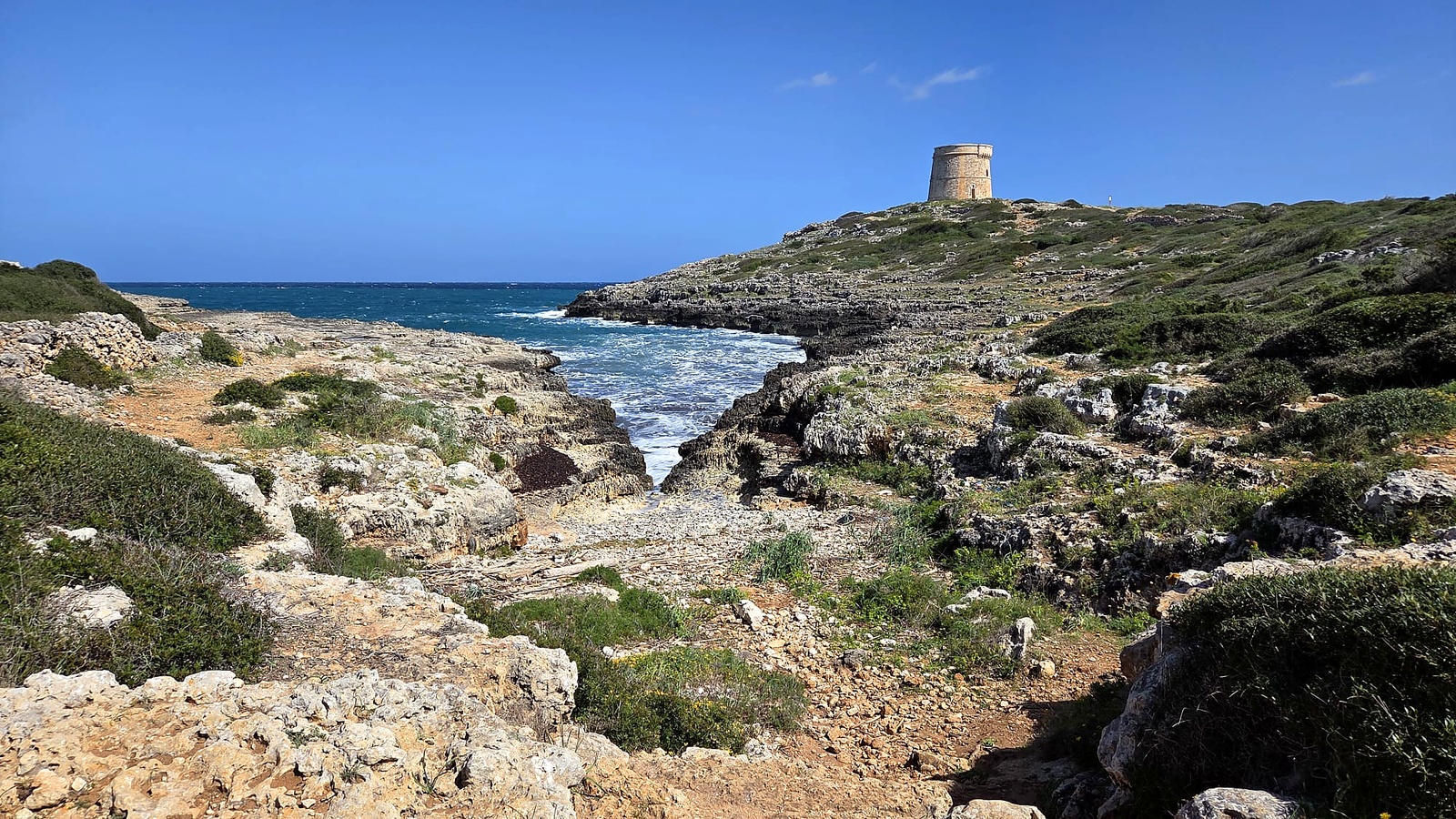
Menorca’s official tourism information currently identifies 14 beaches and coves with full or partial accessibility, while Menorca Airport provides assistance for passengers with reduced mobility and disabilities. That makes an accessible Menorca holiday entirely possible, but it does not mean that every beach, bus, hotel, historic street or famous cove is barrier-free.
The distinction matters. A wheelchair user who can transfer independently has different requirements from somebody who needs an amphibious chair and assistance entering the sea. A traveller who walks with a stick may be comfortable on a paved promenade but unable to manage a steep path, while somebody using a powered wheelchair needs to think about gradients, surface conditions, charging and vehicle access.
Menorca can work extremely well for disabled travellers and visitors with reduced mobility, but good planning is more important here than it is for somebody who can comfortably walk over sand, steps and uneven ground. The island combines genuinely adapted facilities with landscapes that remain deliberately natural, and understanding the difference between the two is the key to planning a holiday that works.
Accessible Menorca: Quick Answers
| Question | Answer |
|---|---|
| Is Menorca wheelchair accessible? | Partly. Menorca Airport, several beaches, developed resorts and many town facilities are accessible, but historic streets, remote coves and natural paths can create significant barriers. |
| Are there accessible beaches in Menorca? | Yes. Official Balearic tourism information currently identifies 14 Menorcan beaches and coves with full or partial accessibility. |
| Are amphibious beach chairs available? | Yes. Current documented provision includes amphibious equipment at beaches such as Cala Santandria, Cala Galdana, Son Bou, Cala en Porter and Es Grau. |
| Is Menorca Airport accessible? | Yes. Aena provides a free assistance service for passengers with reduced mobility or disabilities. Assistance should normally be requested at least 48 hours before the flight. |
| Are Menorca’s buses wheelchair accessible? | Some are. Transportes Menorca currently states that more than half of its vehicles are adapted for passengers with reduced mobility. |
| Can I arrange an adapted transfer? | Yes. Wheelchair-accessible transfer vehicles operate on the island, although advance booking is advisable. |
| Can I use an EU disability parking card? | Yes. European parking cards issued by EU member states are valid in Spain, although some additional concessions depend on local rules. |
| Does a UK Blue Badge automatically work in Menorca? | Not necessarily. Current UK guidance says recognition in Spain, including the Balearic Islands, is decided by local administrations. |
| Is the Camí de Cavalls wheelchair accessible? | Not as a whole. Many sections contain rocky tracks, loose surfaces, slopes and natural terrain unsuitable for a conventional wheelchair. |
| Are Menorca’s famous virgin beaches accessible? | Many are not. Some of the best-known undeveloped coves require significant walking over natural paths or rough ground. |
What Does Accessible Really Mean in Menorca?
Accessibility is not a single standard experience. A place described as accessible might have disabled parking and a ramp to the edge of the sand, while another may provide a boardwalk, adapted toilet, shower, amphibious equipment and staff capable of assisting somebody into the water.
Those differences matter far more than an accessibility symbol on a website.
Official Balearic tourism information describes accessible beaches as locations offering full or partial access to the sand or sea. Facilities may include nearby reserved parking, walkways towards the shoreline or lifeguard point, and technical aids such as amphibious chairs or crutches.
Menorca currently has 14 beaches and coves listed within that broad category: Cala Santandria, Cala Degollador or Platja Gran, Cala en Blanes, Son Xoriguer, Cala Galdana, Son Bou, Cala en Porter, Es Grau, Sant Tomàs, Punta Prima, Arenal d’en Castell, Arenal de Son Saura at Son Parc, Cala Tirant and Na Macaret.
That does not mean all 14 provide identical facilities. Nor should the list be read as a guarantee that every piece of equipment is available every day of the year.
For somebody who depends on a particular facility, the useful question is therefore not simply “Is this beach accessible?” It is “Does this beach provide the specific access and assistance I need when I am visiting?”
Accessible Beaches in Menorca
Several beaches stand out because relatively recent information documents more than basic access.
| Beach | Documented accessibility provision |
|---|---|
| Cala Santandria | Amphibious chair and crutches, ramps, walkway towards the sea, adapted toilet and shower |
| Cala Galdana | Amphibious chairs and crutches, ramps, walkway, adapted toilet and shower |
| Son Bou | Amphibious chair and crutches, amphibious walking aid, ramps, walkway, adapted toilet and shower |
| Cala en Porter | Amphibious chairs and crutches, ramps, walkway and assisted bathing provision |
| Es Grau | Amphibious chair and crutches, ramps, walkway, adapted toilet and shower |
These facilities were included in accessibility information updated during 2026. Bathing assistance, staffing and opening hours can still vary by season and municipality, so anyone who depends on an amphibious chair or assisted entry into the water should confirm current arrangements shortly before travelling.
Cala Galdana
Cala Galdana is one of the strongest options for somebody looking for a recognisable Menorcan beach without the difficult approach associated with many undeveloped coves.
The broad horseshoe bay has pale sand, wooded cliffs and shallow water, yet it is also a developed resort with road access and established beach infrastructure. Current information identifies amphibious equipment, ramps, a walkway towards the water and adapted toilet and shower facilities.
That makes Cala Galdana useful for more than wheelchair users. Travellers who cannot comfortably manage long distances, uneven tracks or steep approaches may find it considerably easier than many of the island’s famous virgin beaches.
Its popularity can create another issue during summer, however. Accessible infrastructure does not remove congestion, so arriving earlier in the day can make parking, transfers and movement around the beach significantly easier.
Son Bou
Son Bou offers a very different type of accessible beach experience. Rather than a compact cove, it is Menorca’s longest stretch of sand, extending well beyond the developed resort area.
Accessibility provision is concentrated towards the serviced end of the beach. Current documented facilities include an amphibious chair, amphibious crutches, an adapted walking aid, ramps, a walkway towards the water and adapted toilet and shower provision.
That illustrates an important point about accessibility information. Saying that Son Bou is accessible does not mean every point along the beach offers the same conditions.
For someone using a wheelchair, the correct entrance can matter more than the name of the beach itself. Heading towards an undeveloped section because it appears quieter on a map could remove many of the advantages provided by the accessible area.
Cala en Porter
Cala en Porter sits between high cliffs and has a developed resort above the bay. The beach itself currently has documented accessibility measures including amphibious chairs and crutches, ramps, a walkway towards the water and assisted bathing provision.
The beach area can therefore work well for somebody with reduced mobility, but the wider geography needs consideration. Cala en Porter is built around significant changes in elevation, and travelling between accommodation, upper resort areas and the shoreline may be much harder than moving around the beach itself.
When choosing accommodation here, distance measured in metres is less useful than understanding the gradient between the property and the places you intend to visit.
Es Grau
Es Grau demonstrates that an accessible beach does not have to feel like a large resort.
The village and bay sit beside the protected landscape of s’Albufera des Grau, with shallow water and a more natural setting than many heavily developed tourist areas. Current accessibility information lists amphibious equipment, ramps, a walkway and adapted toilet and shower facilities.
For travellers who want quieter surroundings while still requiring formal access infrastructure, Es Grau can be an appealing compromise.
As elsewhere, the presence of equipment should not be confused with a permanent promise of assisted bathing. Staffing and seasonal arrangements should be checked when assistance is essential.
Cala Santandria
Cala Santandria lies close to Ciutadella and combines a relatively sheltered beach with established visitor facilities. Current accessibility information includes an amphibious chair and crutches, ramps, a walkway towards the water and adapted toilet and shower provision.
Its location is useful because a beach visit can be combined with accommodation or other activities around the Ciutadella area without travelling across the island.
For somebody who requires multiple accessible elements during the same holiday, staying near a developed town can be more practical than choosing an isolated rural property purely for scenery.
Accessible Does Not Always Mean Assisted Bathing
This is one of the most important distinctions in the guide.
A beach can have an accessible entrance without offering somebody physical assistance into the sea. Another may provide an amphibious chair but only while trained staff or lifeguards are present. Rough conditions can also stop assisted bathing even when all the necessary equipment is available.
A ramp, accessible parking bay or wooden walkway may be entirely sufficient for one visitor and almost irrelevant to another.
Visitors should therefore decide what they actually require before researching individual beaches. Someone who needs level access to the sand is asking a different question from somebody who needs to remain seated while entering the water.
The more specific the requirement, the more important it becomes to confirm current provision directly before making the journey.
What Is an Amphibious Beach Chair?
An amphibious chair is designed to travel over sand and enter the water. Its large wheels and flotation characteristics allow someone who cannot safely walk into the sea to be transferred and supported during bathing.
It is not simply a waterproof wheelchair that can always be collected and used independently. At many beaches, its use depends on assistance from lifeguards or other trained staff.
Sea conditions matter as well. Strong waves, currents or an adverse beach flag can make assisted bathing inappropriate even when the beach is otherwise fully equipped.
For somebody choosing Menorca specifically because they want to swim with assistance, confirming the operating dates and hours of the service should be part of planning the holiday rather than something left until arrival.
Is Menorca Airport Accessible?

Menorca Airport has an established assistance system for passengers with reduced mobility and disabilities.
Aena operates its Sin Barreras, or Barrier-Free, assistance service across its airport network. Passengers whose mobility is limited because of physical, sensory or other disability, age or another condition requiring special assistance can request support through the airport process.
Aena advises passengers to request assistance at least 48 hours before the scheduled departure time to ensure the intended level of service. The airline or travel provider should also be informed, particularly when travelling with a wheelchair, mobility scooter or other specialist equipment.
The airport has accessible toilets throughout the terminal, including facilities designed for passengers with ostomies.
Menorca Airport also participates in Aena’s hidden-disabilities programme. Travellers with a non-visible disability can obtain a badge intended to help airport staff recognise that additional understanding, support or time may be required.
The airport is therefore one of the more predictable parts of an accessible Menorca journey, provided assistance is arranged in advance.
Travelling With a Powered Wheelchair or Mobility Scooter
Airport assistance does not remove the need to tell the airline about mobility equipment.
Airlines can have specific requirements concerning batteries, dimensions, weight and loading procedures. A powered chair accepted by one carrier or aircraft may require different preparation on another.
Provide the airline with accurate equipment information well before travel and ask what preparation is required. If batteries need to be disconnected or protected, arrange this before reaching the gate rather than assuming airport staff will be able to resolve everything immediately.
Photographing the wheelchair or scooter before handing it over can also provide a useful record of its condition.
On arrival, an adapted vehicle should be arranged in advance when a passenger cannot transfer into a standard car.
Arriving in Menorca by Ferry
Ferry travel can be particularly useful for people bringing their own adapted vehicle or larger mobility equipment, but accessibility depends on the vessel as well as the port.
Official Balearic tourism guidance advises passengers travelling through Ciutadella to check the accessibility of the particular ship being used. Not every vessel offers identical arrangements, and passengers travelling by car should establish whether there is lift access from the vehicle deck.
This is an area where checking the company name alone is not enough. Ferry fleets contain different vessels, and operational substitutions can occur.
Anybody unable to use stairs should therefore confirm the boarding procedure and the accessibility of the actual vessel before travelling.
Are Menorca’s Buses Wheelchair Accessible?
Public transport accessibility is improving, but it should not be treated as universal.
Transportes Menorca, one of the island’s main bus operators, currently states that more than 50% of its vehicles are adapted for passengers with reduced mobility. Adaptations include wheelchair ramps and reserved wheelchair spaces, while vehicles are also being equipped with systems supporting passengers with visual or hearing disabilities.
That is useful progress, but “more than 50%” also means that a passenger should not assume every departure will use an adapted vehicle.
This matters particularly on services with limited frequency or seasonal routes to beaches. Missing one suitable bus may have a much greater impact when the next service is some time away.
A wheelchair user planning an important journey should confirm the specific service with the operator rather than relying solely on a general statement that buses are accessible.

Accessible Taxis and Private Transfers
Wheelchair-accessible road transfers are available in Menorca, including vehicles designed to carry passengers who remain seated in their wheelchair.
Advance booking is advisable. Menorca is a relatively small island and does not have the volume of accessible vehicles that might be available in a major city.
When booking, provide the dimensions and approximate weight of the wheelchair, explain whether the passenger can transfer into a normal vehicle seat and confirm whether a ramp or other loading arrangement is required.
The same care should be taken with the return journey to the airport. An adapted transfer is not something worth leaving until the morning of an early flight.
Hiring a Car With Reduced Mobility
For some travellers, a car gives much greater independence than relying on bus timetables and transfers.
A European disability parking card issued by an EU member state is valid in Spain. The card should be displayed visibly, and it allows the holder to use designated disabled parking spaces when travelling in the vehicle.
Some additional parking concessions vary by municipality. These can include rules concerning paid parking, loading areas or restricted traffic zones, so the card should not be interpreted as permission to park anywhere.
UK Blue Badge holders need more caution. Current British government guidance states that recognition of the UK Blue Badge in Spain, including the Balearic Islands, is decided by local administrations. The UK and Spain have been working towards broader mutual recognition, but British visitors should check current local rules rather than assuming that a badge automatically carries every concession they would receive at home.
Regardless of the card being used, pedestrian areas, crossings and places where stopping is prohibited remain restricted.
Ciutadella With Reduced Mobility
Ciutadella is one of Menorca’s most rewarding towns, but its historic character means route selection matters.
Around Plaça des Born and much of the central area, visitors can find relatively manageable streets and accessible routes between shops, cafés and historic buildings. Ciutadella Cathedral also has an accessible side entrance.
The harbour introduces more of a challenge because of the difference in height between parts of the old town and the waterfront.
Official Balearic accessibility guidance highlights the Camí de Baix as a particularly useful route. It follows the natural harbour on relatively level ground towards Castell de Sant Nicolau.
Access to the marina can involve either stairs or the vehicle route. The road option is steep, although official guidance notes that it can be manageable with an electric wheelchair, mobility scooter or assistance.
For someone who tires easily, it may be better to treat the harbour and historic centre as separate parts of the day rather than trying to link every attraction on foot.
Maó With Reduced Mobility
Maó presents a different accessibility challenge because its historic centre sits well above the harbour.
Both areas can be enjoyable in their own right. The upper town contains shops, markets, squares and cultural attractions, while the waterfront offers restaurants, boats and views across one of the Mediterranean’s great natural harbours.
The difficulty is often the transition between them.
Visitors who find steep gradients challenging should consider transport between harbour level and the centre rather than assuming that the most picturesque walking route will also be the easiest one.
This is a recurring lesson in accessible travel around Menorca. A destination can be manageable once you arrive while the route between two neighbouring areas presents the real barrier.
Are Menorca’s Virgin Beaches Wheelchair Accessible?
Many are not, and this is an area where travel guides should be clear rather than optimistic.
The isolation of Menorca’s undeveloped beaches is part of their appeal. That same isolation frequently means unpaved tracks, woodland paths, rocks, loose ground, gradients and significant walking between a parking area and the shore.
Official visitor information acknowledges that access to many virgin beaches is not easy.
Cala Pilar is one of the clearest examples. It is described as one of the island’s beaches with the most difficult access, and reaching the shore involves roughly half an hour of walking after leaving the car park.
Cala Trebalúger is more demanding. Access normally involves continuing beyond Cala Mitjana, with uneven natural terrain and sections through woodland. This should not be treated as an independent wheelchair route.
Cala Mitjana and Mitjaneta also involve travelling from the parking area through countryside before reaching the coast.
These beaches are not failures of accessibility in the same way that an inaccessible public building might be. They are undeveloped natural landscapes. The important thing is that travellers know what to expect before arriving.
Someone with reduced mobility can still experience Menorca’s natural coast through more accessible beaches, viewpoints, harbours and developed stretches of shoreline without having to reproduce every route featured in a conventional beach guide.
Is the Camí de Cavalls Wheelchair Accessible?
The Camí de Cavalls should not be described as a generally wheelchair-accessible path.
It circles Menorca through a wide variety of landscapes, including rocky coastline, woodland, dunes, farm tracks, hills and exposed natural terrain. Difficulty changes considerably from one section to another.
Some short approaches or nearby promenades may be manageable, particularly with specialist equipment, but large parts of the route would be impractical for a conventional wheelchair or mobility scooter.
This distinction is important because the name “path” can create the wrong impression. The Camí de Cavalls is not an island-wide paved promenade.
An all-terrain wheelchair may make particular stretches possible for some users, but that is very different from saying the trail itself provides step-free wheelchair access.
Choosing Accessible Accommodation in Menorca
The words “accessible room” tell you surprisingly little on their own.
One guest may need only a lift and a grab rail. Another may require a completely step-free route, a roll-in shower, enough turning space for a powered chair, a specific bed height and sufficient room beside the bed for a transfer.
Ask the accommodation provider about the complete route from the arrival point to the bedroom rather than the bedroom alone.
Reception, restaurants, breakfast rooms, terraces, pools and other facilities should be considered separately. A genuinely adapted room does not guarantee that every part of a hotel can be reached without steps.
Photographs can be more useful than general descriptions. Ask for recent pictures of the entrance, bathroom, shower, route to the pool and any other area that matters to the traveller.
Location should also form part of the accessibility decision. Staying close to a suitable beach may remove the need to arrange an adapted transfer every day.
For someone whose priority is assisted bathing, accommodation close to Cala Galdana, Son Bou or another beach with documented equipment may be more useful than a beautiful property several kilometres away.
Mobility Scooters in Menorca
Mobility scooters can work extremely well around resorts, promenades and many town centres, particularly for travellers who can walk short distances but cannot comfortably cover several kilometres.
Surface and gradient are usually more important than distance.
Two kilometres of flat promenade may be easier than 300 metres of steep paving. Loose gravel, deep sand and rocky tracks can quickly exceed the abilities of a standard folding scooter.
Battery range also changes when repeated hills are involved, particularly in warm weather and when carrying additional weight.
When researching a route, ask how steep it is and what the surface is made from rather than simply checking how far away the destination appears on a map.

Accessible Toilets and Changing Facilities
Adapted toilet and shower facilities are documented at several of the accessible beaches discussed earlier, but they should not be assumed to exist everywhere.
Facilities can also be seasonal. A building may remain beside a beach throughout the year even when associated services, staff or bathing assistance have finished for the season.
This is particularly relevant in spring and autumn.
For somebody who depends on an adapted toilet, identifying facilities before leaving accommodation is considerably more reliable than hoping that a developed beach will have one.
Menorca Airport is more straightforward, with accessible toilets distributed throughout the terminal and specific provision for passengers with ostomies.
Accessible Menorca Outside July and August
May, June, September and October can be attractive months for travellers who find extreme heat difficult or prefer quieter surroundings.
Lower temperatures and reduced crowds can make moving around towns considerably easier. Parking may also be less competitive, and promenades can feel more comfortable than during the busiest summer weeks.
The trade-off is seasonal services.
An amphibious chair listed among a beach’s facilities may depend on lifeguards or bathing-assistance staff who do not operate throughout the year. Beach buses can change frequency, while some seasonal routes stop entirely.
Physical infrastructure such as ramps and boardwalks may remain, but the service that turns basic physical access into assisted access can disappear outside the main season.
Anyone travelling specifically for assisted bathing should therefore check dates rather than assuming that warm sea temperatures mean the summer service is still operating.
Accessibility Is About More Than Wheelchairs
Reduced mobility covers a far wider group of travellers than full-time wheelchair users.
An older visitor may be completely independent on flat ground but unable to manage a steep flight of steps. Somebody recovering from surgery may simply need shorter walking distances and regular seating. A visitor with a visual impairment faces different barriers again, while somebody with a hidden disability may need more time, quieter surroundings or additional assistance rather than physical adaptations.
Good accessibility information therefore describes the environment rather than merely attaching a wheelchair symbol to it.
“Level paved route followed by a wooden walkway across the sand” is more useful than simply saying “accessible”.
The same principle applies to accommodation, public transport and attractions. Giving specific information allows the traveller to decide whether a place works for their individual circumstances.
Healthcare During an Accessible Menorca Holiday
Visitors whose reduced mobility is related to a medical condition should consider healthcare access when choosing accommodation.
Menorca’s principal public hospital, Hospital General Mateu Orfila, is in Maó, while primary healthcare and urgent-care services are distributed around the island.
Someone requiring frequent medical treatment, specialist equipment or medication that would be difficult to replace may prefer straightforward road access to Maó or Ciutadella rather than an isolated rural property.
British visitors should remember that an EHIC or GHIC does not replace travel insurance. The cards can provide access to medically necessary state healthcare under the applicable arrangements, but they do not cover every private service, repatriation or many travel-related costs.
Any mobility requirement should also be explained when arranging transport to healthcare. A standard taxi may not be suitable for somebody who needs to remain in an occupied wheelchair.
Planning an Accessible Menorca Holiday
The best accessible holiday is usually planned around the barriers that would actually prevent the trip from working.
Airport assistance and airline requirements for powered equipment should be confirmed before travel. Accommodation should be checked beyond the bedroom, including the route to reception, restaurants and swimming areas. Transport should be considered according to the specific wheelchair or mobility aid rather than simply whether a taxi or bus exists.
For beach days, identify the correct entrance and establish whether the equipment or bathing assistance you need will be operating. Weather also needs to be taken into account because rough seas can interrupt assisted bathing even at a well-equipped beach.
If driving, understand the parking rules that apply to the card you are carrying. This is particularly important for visitors relying on a UK Blue Badge.
It is equally useful to have alternatives. A windy day that makes assisted bathing impossible can still work well for visiting Ciutadella, Maó or another suitable attraction.
Is Menorca Good for Disabled Travellers?
Menorca cannot accurately be described as completely barrier-free. Historic centres contain old paving and gradients, many famous natural coves require walking, not every bus is adapted and parts of the coastline are intentionally undeveloped.
At the same time, the island offers far more accessible infrastructure than somebody looking only at photographs of rocky paths and hidden beaches might expect.
Menorca Airport has established disability assistance. Several beaches have documented amphibious bathing equipment and adapted facilities. Accessible transfer vehicles operate on the island, European disability parking cards are recognised, public transport includes adapted vehicles, and developed coastal areas provide alternatives to difficult natural paths.
The result is not a choice between experiencing Menorca and remaining at the hotel. It is a question of choosing the parts of the island that match the traveller’s requirements.
Cala Galdana does not become less beautiful because it has a boardwalk. Es Grau does not lose its natural character because somebody using a wheelchair can reach the beach. Ciutadella remains historic whether a visitor reaches the harbour by a flatter route or by steps.
Accessibility is not about forcing every traveller to follow the same itinerary. It is about providing enough accurate information and practical infrastructure for people to experience Menorca in a way that works for them.
Research and Methodology
This guide was researched using current information from Aena, the official Balearic Islands tourism portal, Visit Menorca, Spanish government accessibility information, UK government Blue Badge guidance, 2026 accessible-beach information and current public-transport information from Menorca operators.
Beach facilities have been described as current documented provision rather than permanent guarantees. Equipment, staffing, lifeguard periods and assisted-bathing hours can change between seasons and municipalities, so travellers who depend on a particular facility should confirm it shortly before travelling.
The distinction between basic physical access and assisted access is deliberate. A ramp or nearby disabled parking space does not necessarily make a beach suitable for every wheelchair user, just as the existence of an amphibious chair does not guarantee assisted bathing outside its staffed operating period.
The guide also avoids describing an entire resort, town or trail as accessible simply because one part of it is. Gradient, surface, distance, season, transport and individual mobility requirements can all alter the practical experience.
Last independently researched and checked: September 2026.