Why Maó Is Unlike Any Other Mediterranean Port
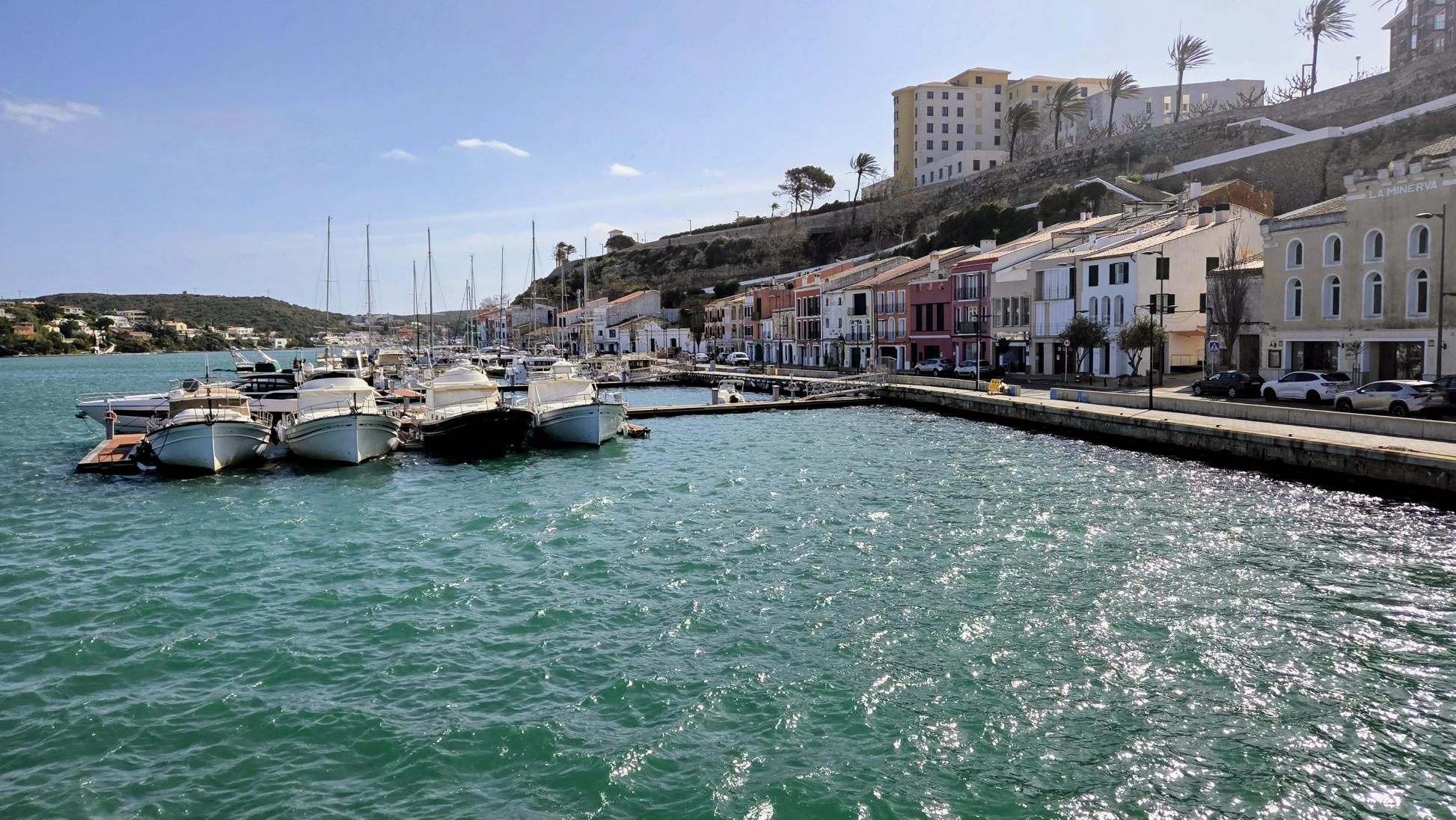
Maó is one of the Mediterranean’s most historically layered harbour cities. While many Mediterranean ports present history as scenery, Maó presents history as infrastructure.
The capital of Menorca was never simply a seaside settlement. Its identity was shaped by one of the largest natural harbours in the Mediterranean, a deep and narrow inlet that has functioned, across different eras, as a military base, quarantine barrier, commercial gateway and cultural receiver.
Maó is not simply Menorca’s capital. It is one of the Mediterranean’s most historically layered harbour cities, shaped by Roman administration, British naval strategy, quarantine systems, language, ritual and maritime trade.
That layered history still survives across the city today.
Not only in monuments, but in:
- Harbour fortifications
- British-influenced architecture
- Religious archives
- Menorcan language fossils
- Gin culture
- Ritual festivals
- Military landscapes
- Maritime institutions
Maó is best understood not as a postcard town, but as a living historical system where each layer remains partially active.
Maó’s Historical Layers at a Glance
| Historical Layer | Main Legacy | Where to Experience It |
|---|---|---|
| Talayotic Menorca | Ritual landscapes and monumental settlements | Cornia Nou, Sa Cudia Cremada |
| Roman Magona | Imperial administration and written history | Museu de Menorca |
| Early Christianity | Harbour basilicas and religious networks | Illa del Rei |
| Islamic Manûrqa | Agricultural systems and place names | Rural hinterland |
| British Maó | Architecture, gin culture and maritime identity | Harbour district, Georgian influences |
| Bourbon and Modern Era | Civic institutions and archives | Teatre Principal, Lazaretto |
Timeline of Maó Through the Ages
Maó’s history is best understood as a sequence of historical layers, each one adding new meaning to the harbour, the town and the surrounding landscape.
| Period | What Happened | Why It Matters |
|---|---|---|
| c. 2300 BCE | First settlers reached Menorca | Established the island’s earliest human landscape |
| Iron Age | Talayotic ceremonial landscapes developed | Created the prehistoric foundations around modern Maó |
| 123 BCE | Roman conquest of Menorca | Integrated Maó into the Roman Mediterranean world |
| 418 CE | The Letter of Severus described events in Magona | Gave Maó rare written visibility in late antiquity |
| 6th century | Early Christian basilicas flourished | Linked the harbour to religious and maritime life |
| 10th–13th centuries | Islamic Manûrqa shaped the island | Left traces in place names, agriculture and land organisation |
| 1287 | Crown of Aragon conquest | Reorganised Maó through Christian rule and civic structures |
| 1708–1802 | British rule transformed Maó | Added naval infrastructure, gin culture, language influence and architecture |
| 1793–1807 | The Lazaretto was constructed | Made Maó a major Mediterranean quarantine harbour |
| 1829 | Teatre Principal opened | Marked Maó’s growth as a civic and cultural centre |
| 20th century | Modern civic expansion continued | Strengthened the city’s role as an archival, cultural and administrative capital |
This timeline shows why Maó is not defined by one civilisation or period. Its identity comes from accumulation: prehistoric settlement, Roman administration, Christian harbour culture, Islamic land systems, British naval strategy and modern civic memory.
Talayotic Maó Menorca
Long before Maó existed as a recognisable town, the surrounding landscape was already structured and inhabited as part of a coherent cultural system.
The Talayotic civilisation organised Menorca into a network of monumental spaces, including:
- Ceremonial gathering sites
- Defensive towers
- Ritual enclosures
- Long-term settlement patterns
Around modern Maó, sites such as Cornia Nou and Sa Cudia Cremada demonstrate that this area was not marginal, but part of a dense and active prehistoric landscape.
These were not static or abandoned structures. Archaeological evidence suggests continued use into the later Iron Age, at a time when Menorca was increasingly connected to wider Mediterranean trade and conflict.
Rather than forming a distant prehistory, the Talayotic layer establishes the first version of Maó’s enduring pattern: a strategically positioned landscape shaped by organisation, movement and external interaction.
Why the Talayotic Layer Matters
The prehistoric landscape explains a central fact about Maó. The town did not emerge from empty land.
It was inserted into an already organised cultural territory, shaped by movement, visibility and control long before the modern harbour became dominant.
Talayotic settlements established patterns of positioning, defence and ritual use that influenced how later populations understood the same space. The choice of location, the relationship to surrounding land and the emphasis on strategic vantage points were not new developments, but continuations of earlier logic.
In this sense, Maó’s later role as a harbour of empires did not begin in the Roman or British periods.
It extended a much older system in which landscape, structure and external connection were already closely linked.
Roman Magona
Roman conquest integrated Menorca into a wider imperial Mediterranean system, transforming the island from a regional territory into a structured administrative and maritime node.
Maó, then known as Magona, became part of a strategic network connecting Iberia, North Africa and Italy. Its importance lay not only in location, but in its function as a controllable harbour within a system of movement, taxation and military logistics.
One of the most significant surviving documents from late antiquity, the Letter of Severus from 418 CE, records events in Magona, including the forced conversion of the island’s Jewish population.
This text does more than document a local incident. It places Maó within the wider religious and political conflicts of the late Roman world, giving the city an unusual level of visibility for its size.
In contrast to many Mediterranean ports whose early histories are reconstructed primarily through archaeology, Maó appears directly in written narrative.
This dual presence, both material and textual, marks an important shift. The city is no longer only a place of settlement and exchange, but a place of record, conflict and interpretation within the imperial system itself.
Roman Legacy in Maó
| Roman Influence | Impact on Maó |
|---|---|
| Maritime integration | Connected Maó to imperial trade routes |
| Municipal status | Integrated the town into Roman administration |
| Written records | Created rare documentary visibility |
| Religious transition | Helped shape early Christian Menorca |
The Roman period transformed Maó from a regional settlement into a documented Mediterranean harbour.
Early Christian Maó
One of the most distinctive aspects of Maó’s history is that early Christianity survives primarily around the harbour rather than within the historic urban core.
The clearest example is the early Christian basilica on Illa del Rei, located within the harbour itself. This positioning is not incidental. It reflects a model in which religious life was closely tied to maritime movement, exchange and control.
Rather than developing as an inland ecclesiastical centre, Maó functioned as a Christian harbour system, where spiritual authority, trade routes and strategic geography were interlinked.
The harbour was not simply an economic space. It operated as a threshold through which people, goods and beliefs passed, making it central to both religious transformation and political influence.
In this context, early Christian Maó is best understood not as a city with a harbour, but as a harbour that structured the city’s religious and institutional life.
Illa del Rei
TodaIlla del Rei presents one of the most concentrated expressions of Maó’s layered history.
Today, the island combines several distinct historical phases within a confined and clearly legible setting:
- Early Christian basilica remains
- Eighteenth-century naval hospital infrastructure
- British military adaptations
- Modern restoration and conservation work
- Contemporary cultural and exhibition spaces
What makes Illa del Rei particularly significant is not the presence of these elements individually, but their accumulation without erasure. Each phase has been built over, alongside or within the previous one, preserving traces of earlier functions rather than replacing them entirely.
The site therefore operates as a compressed version of Maó itself.
It demonstrates how the harbour has been repeatedly reinterpreted across different periods, adapting religious, military and cultural uses to the same strategic location.
In this sense, Illa del Rei is not simply a historical site within Maó. It is one of the clearest examples of how the city constructs continuity through reuse, where each layer remains partially visible within the next.
Islamic Manûrqa
The Islamic period in Menorca left fewer monumental traces inside Maó itself, but its influence remains dThe Islamic period in Menorca left fewer visible monumental traces within Maó itself, yet its influence remains deeply embedded in the island’s underlying structure.
Its legacy survives through:
- Agricultural vocabulary
- Irrigation systems and water management
- Settlement patterns
- Toponymy
- Rural land organisation
Unlike later periods, particularly British rule, Islamic Menorca is not easily read through architecture.
It is instead preserved in systems.
Land division, cultivation practices and place names continue to reflect a period in which the island was reorganised according to new social, economic and environmental logics. These patterns persisted beyond the end of Islamic rule, adapting to later administrations rather than disappearing entirely.
As a result, this layer is often overlooked by visitors. It does not announce itself through monuments, but requires interpretation through landscape and language.
Yet it remains essential to understanding the formation of Menorca before the Crown of Aragon conquest in 1287, and to recognising how later societies inherited and reused an already structured territory.
British Maó Menorca
British rule did not simply occupy Maó. It reconfigured it.
Between the early 18th and early 19th centuries, Menorca became strategically central to British naval operations in the Mediterranean. Maó’s harbour, with its depth, shelter and defensibility, was one of the principal reasons for this interest.
The result was not only military control, but systemic transformation.
The city adapted to serve as a naval base, a commercial gateway and a point of international contact. Infrastructure, architecture and daily life were reshaped to support these functions.
British Influence Still Visible Today
| British Legacy | Modern Survival |
|---|---|
| Naval infrastructure | Harbour fortifications and military sites |
| Georgian influence | Sash windows and urban planning |
| Boinders | Menorcan adaptation of bow windows |
| Gin production | Gin de Mahón tradition |
| Maritime trade culture | Cosmopolitan harbour identity |
British Maó is best understood as a period of integration rather than domination.
The harbour became a point of convergence where ships, merchants, naval officers and administrators interacted within a shared system. Language adapted, architectural forms were absorbed and local practices incorporated foreign elements without losing their underlying structure.
This process produced a city that was neither fully British nor entirely local, but something more complex.
A hybrid maritime culture shaped by repeated contact, adaptation and exchange.
In this sense, the British period did not overwrite Maó’s identity. It intensified its defining characteristic.
The ability to absorb external influence while remaining structurally continuous.
Menorcan Words with English Origins
Language remains one of the clearest and most persistent indicators of British influence in Maó.
During the 18th century, sustained contact with British naval and administrative presence introduced English vocabulary into everyday Menorcan Catalan. Many of these terms did not disappear with the end of British rule. Instead, they were absorbed, adapted and normalised within local speech.
| English Origin | Menorcan Form | Meaning |
|---|---|---|
| Boy | Boi | Child |
| Bow Window | Boinder | Architectural feature |
| Pudding | Púdin | Dessert |
| Chalk | Xoc | Material |
| Shoemaker | Xumèquer | Trade |
What makes these words particularly significant is not their origin, but their transformation.
They have been phonetically adapted to fit Menorcan pronunciation and integrated into daily usage, no longer perceived as foreign insertions but as part of the local linguistic system.
This distinguishes them from modern global English influence. These are not contemporary borrowings, but historical residues tied specifically to a defined period of occupation and contact.
Language in Maó therefore behaves as a form of cultural sediment.
Even where architectural forms have changed or military structures have been repurposed, these words continue to preserve a record of interaction between local society and imperial presence. They remain among the most durable and least visible traces of the city’s layered past.
The Lazaretto and Quarantine Harbour
OOne of the most distinctive and structurally revealing sites in Maó Harbour is the Lazaretto.
Constructed between 1793 and 1807, the complex was designed as a quarantine fortress, intended to regulate the movement of people and goods entering the Mediterranean through maritime trade. Rather than functioning as a medical facility in a modern sense, it operated as a system of classification, separation and control.
Ships arriving in Maó were assessed according to levels of suspected risk, and their crews were distributed across a series of enclosed zones. These spaces were organised to prevent contact between groups, creating a controlled environment in which disease could be contained without halting trade entirely.
This reveals a critical dimension of Maó’s harbour.
It functioned not only as a military and commercial infrastructure, but also as a mechanism for managing uncertainty. The Lazaretto represents the point at which maritime trade, state authority and public health became physically inseparable.
Teatre Principal and Civic Maó
By tBy the 19th century, Maó began to transition from an imperial naval base into a civic and cultural centre.
The opening of the Teatre Principal in 1829 marked a visible shift in the city’s function. Previously defined by military presence and maritime control, Maó increasingly developed institutions concerned with education, culture and public life.
Today recognised as one of Spain’s oldest opera houses, the theatre represents more than a performance venue. It reflects the consolidation of a new urban identity, grounded in administration, intellectual activity and civic organisation.
This transformation was accompanied by the expansion of:
- Public archives and record systems
- Educational institutions
- Commercial administration
- Newspaper culture and local press
- Learned societies and intellectual networks
These developments did not replace the harbour’s importance, but reinterpreted it.
Maó evolved from a space defined primarily by movement and control into one capable of recording, analysing and transmitting its own history.
In this sense, the city did not cease to be a harbour.
It became a harbour of a different kind.
Not only of ships and goods, but of documents, ideas and institutional memory.
Maó’s Living Traditions
Maó’s cultural identity survives most clearly not in monuments, but in habit.
Many of the city’s most important traditions are not staged as heritage. They continue as everyday practices, embedded in work, ritual and language.
These survivals are not static. They are the result of adaptation, where older systems have been absorbed into modern life without being fully replaced.
Living Traditions of Maó
| Tradition | Cultural Meaning |
|---|---|
| Gin de Mahón | Legacy of British-era trade adapted into local identity |
| Mahón cheese production | Continuity of agrarian systems shaped by landscape |
| Santa Maria organ culture | Persistence of sacred and civic musical tradition |
| Gràcia horse rituals | Integration of religious, social and public ceremony through Menorcan festival identity |
| Harbour processions | Maritime religious continuity |
What defines these traditions is not simply their survival, but the way they continue to function within the same spatial and social frameworks that produced them.
Gin is still tied to the harbour economy that introduced it. Cheese production remains dependent on environmental conditions shaped over centuries. Religious music and festival processions still move through the same urban routes that structured earlier civic life.
In this sense, Maó does not preserve its past by isolating it.
It preserves it by continuing to use it.
These traditions act as active carriers of historical memory, maintaining connections between different layers of the city without requiring formal reconstruction or interpretation.
They also reveal an important distinction.
In Maó, continuity is not maintained through spectacle or heritage presentation, but through repetition. Practices endure because they remain embedded in the rhythms of everyday life.
This allows the city to retain depth without becoming a museum. Its history is not displayed at a distance. It is lived, often without being consciously recognised as such.
Maó’s Most Atmospheric Legends
Maó’s folklore is unusually tied to real historical trauma and political memory. Its legends are rarely generic ghost stories. Instead, they often emerge from military occupation, quarantine fears or religious transformation.
The White Lady of La Mola
The legend of the White Lady associated with La Mola is one of the most persistent and recognisable narratives attached to Maó’s military landscape.
It is generally linked to real events during the Civil War in 1936, when violence, executions and confinement left a lasting imprint on the fortress and its surrounding territory. Later accounts, particularly from soldiers stationed at the site, describe sightings of a solitary figure dressed in white, often appearing along the cliffs or within the defensive structures.
These reports are not easily separated from the conditions in which they emerged.
La Mola is an environment defined by exposure. The fortress sits at the edge of the harbour, where wind, isolation and distance from the town create a heightened sensory experience. Sound carries unpredictably across stone, movement is difficult to locate and the landscape itself feels detached from ordinary urban life.
Within such a setting, perception becomes unstable.
Night watch duties, long periods of silence and the repetitive routines of military life contribute to a state in which small stimuli can take on disproportionate significance. The combination of architectural scale, open sea frontage and extreme weather conditions produces an atmosphere that encourages interpretation.
The persistence of the White Lady legend can therefore be understood as a convergence of factors:
- Historical trauma linked to the Civil War
- Oral transmission within military communities
- Acoustic and visual distortions produced by the environment
- The psychological effects of isolation and vigilance
Rather than existing as a conventional ghost story, the figure functions as a form of memory embedded in place.
The fortress does not merely host the legend. It generates the conditions that sustain it.
In this sense, the White Lady of La Mola is not an interruption of history, but a continuation of it, shaped by landscape, architecture and the unresolved experiences tied to the site.
The Haunted Lazaretto
The Lazaretto developed a long-standing reputation as an “enchanted” or haunted place, but its atmosphere is best understood through its function rather than through folklore alone.
Constructed as a quarantine fortress between the late 18th and early 19th centuries, the Lazaretto was designed to separate, classify and control human bodies according to risk. Ships entering the harbour were assessed, and their crews were divided into zones depending on suspected exposure to disease.
This created a highly ordered landscape of uncertainty.
Individuals were isolated from one another, watched, processed and contained within an architectural system built specifically to manage fear of the invisible. Illness could not always be seen, and that ambiguity shaped the experience of the place.
The geometry of the Lazaretto reflects this logic.
- Segmented enclosures
- Controlled circulation routes
- Observation points
- A centralised chapel linking spiritual and medical authority
The result was an environment in which movement was restricted, identity was reduced to perceived contagion and time itself became uncertain.
Across weeks or months of confinement, the boundary between physical illness and psychological strain became increasingly blurred. For those held within the system, the experience was not only medical but existential.
It is from this context that the Lazaretto’s reputation emerges.
Reports of unease, disorientation and unexplained sensations are not unusual in such spaces. They reflect the afterlife of a place designed to isolate individuals under conditions of fear, silence and partial knowledge.
Unlike conventional ghost narratives, the Lazaretto’s atmosphere does not rely on invention. It is produced by architecture, memory and function.
The site does not suggest haunting in a supernatural sense.
It reveals how environments constructed to control uncertainty can continue to generate it long after their original purpose has ended.
The Naming of Maó and Mahón
Another longstanding question surrounding the city is its name, and why it appears in two forms: Maó and Mahón.
Historically, the ancient settlement is recorded as Mago or Magona in Roman and late antiquity sources. The origin of this name is often linked, in later tradition, to the Carthaginian general Mago Barca, although this connection remains debated and cannot be firmly proven in archaeological terms.
The modern divergence between Maó and Mahón reflects not ancient origins, but later linguistic and political layers.
- Maó is the Catalan form, used locally and officially within Menorca and the Balearic Islands.
- Mahón is the Castilian Spanish form, introduced and standardised during periods of stronger central Spanish administration, particularly from the 18th century onwards.
During British rule, both forms circulated alongside English adaptations, reinforcing the city’s fluid identity as an international port.
The coexistence of Maó and Mahón today is not simply a translation issue. It reflects the island’s shifting political history and the interaction between local language, imperial administration and national identity.
In this sense, the name itself behaves like the city it describes:
a structure shaped by successive layers, rather than a single fixed origin.
Best Historical Sites in Maó
| Site | Why It Matters |
|---|---|
| Museu de Menorca | Best overview of the island’s historical layers |
| Illa del Rei | Early Christianity and naval history |
| La Mola Fortress | Strategic military architecture |
| Lazaretto | Mediterranean quarantine system |
| Santa Maria Church | Organ culture and religious continuity |
| Cornia Nou | Talayotic ceremonial landscape |
| Arxiu Històric de Maó | Key archive for Menorcan history |
How to Understand Maó Properly
Many visitors experience Maó superficially.
They see:
- A scenic harbour
- Restaurants and marinas
- Georgian-style façades
- Seasonal tourism
This perspective captures appearance, but not structure.
The city becomes far more intelligible when understood as a layered Mediterranean system, shaped by centuries of adaptation rather than a single historical moment.
Each phase of Maó’s development did not replace what came before. It reused it.
- Talayotic landscapes established patterns of position and control
- Roman administration introduced documentation and integration
- Christian networks linked the harbour to religious authority
- Islamic systems reorganised land, water and settlement
- British rule reconfigured the city as a naval and commercial node
- Bourbon and modern institutions formalised civic and archival life
This process produced a cumulative environment in which earlier structures continue to inform later ones.
The result is not a city defined by a single identity, but one shaped by continuity across different historical systems.
Maó is therefore best understood not as a sequence of past eras, but as a place where those eras remain partially active within the present.
This is what gives the city its unusual density and coherence within the context of the Balearic Islands.
Why Maó Is One of the Mediterranean’s Most Important Harbour Cities
Maó matters because it reveals how Mediterranean history actually functioned.
Not as a sequence of isolated civilisations, but as a system of continuous overlap.
Across centuries, military powers, religious movements, traders, migrants and languages passed repeatedly through the same harbour. Each arrival did not erase what came before. It adapted it, reused it and left traces that remained active within the next phase.
The result is a city where different layers of history operate simultaneously.
They are visible in:
- Architecture shaped by successive influences
- Rituals that still follow historic routes
- Language that preserves earlier contact
- Food traditions tied to trade and environment
- Urban form structured by defence and movement
- Archives that record the city’s long continuity
- A harbour that still defines its identity
What distinguishes Maó is not the presence of these elements individually, but their coherence. Very few Mediterranean cities preserve this continuity without fragmenting it into isolated heritage. It feels layered, visible and still active within the harbour itself.
In Maó, the past has not been separated from the present. It remains embedded in the structure of the city itself. For that reason, Maó is not a place that reveals itself quickly.
It is a city that rewards slow understanding
Common Questions About Maó (Mahón), Menorca
Why is Maó important in Mediterranean history?
Maó was strategically important because its natural harbour allowed military fleets, merchants and empires to control movement across the western Mediterranean. Romans, British forces and Spanish administrations all used the harbour as a naval and commercial base.
What is Gin de Mahón?
Gin de Mahón is Menorca’s traditional gin, originally influenced by British naval culture during the 18th century. It is made using grape spirit and juniper berries and remains one of the island’s most distinctive products.
What does Maó mean?
The origin of the name Maó is debated. It is often linked to Mago Barca, brother of Hannibal, although historians cannot fully confirm this connection.
What is Illa del Rei?
Illa del Rei is a small island inside Maó Harbour known for its early Christian basilica, British naval hospital and modern cultural centre.
Is Maó worth visiting?
Yes. Maó is one of the most historically layered cities in the Balearic Islands and offers a combination of harbour culture, architecture, military history, archaeology, food culture and Mediterranean identity.