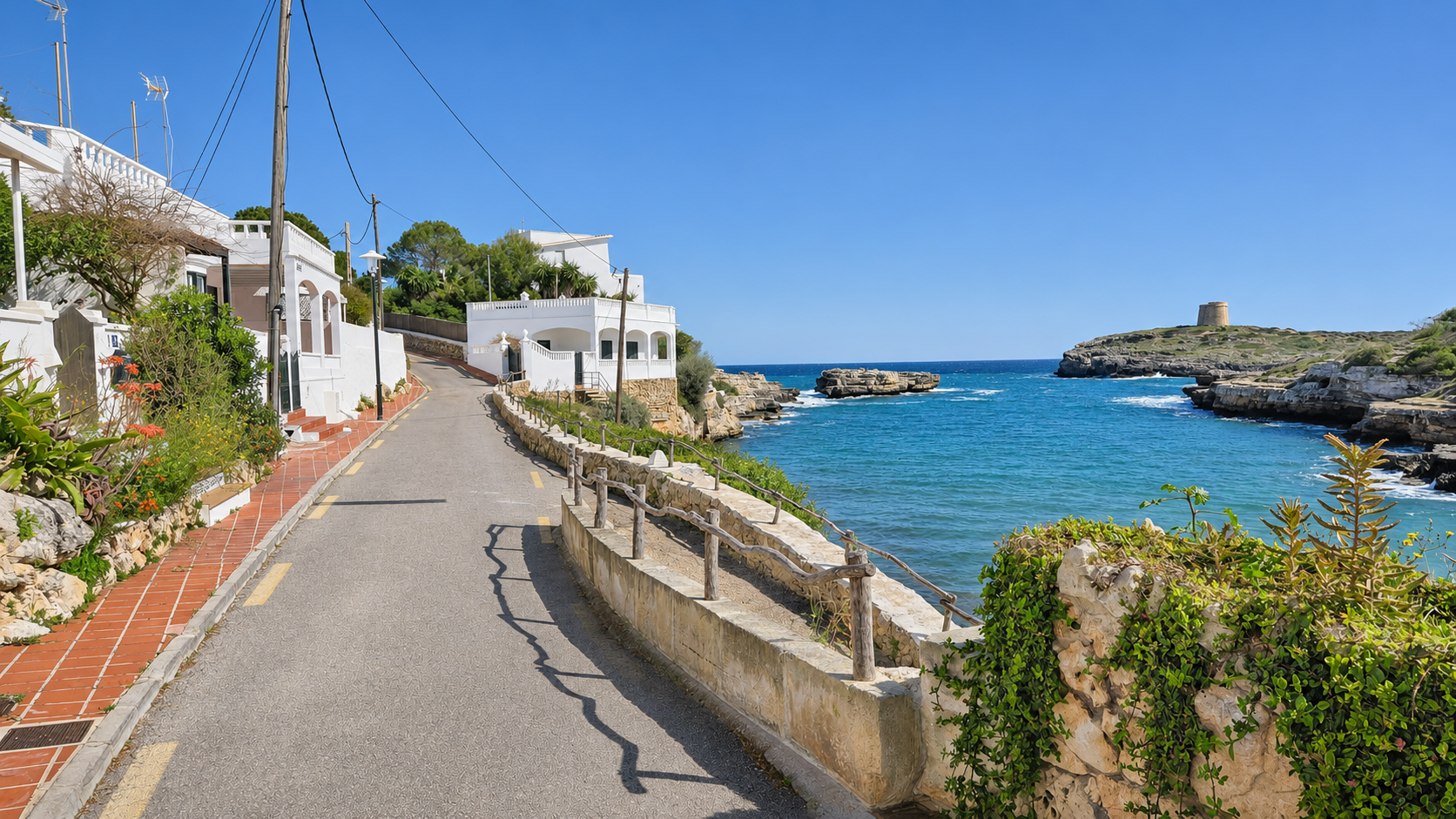
Menorca has taken a significant step towards restricting the number of vehicles entering the island after the Balearic Parliament approved amendments to its Biosphere Reserve Law on 24 November 2026. The legislation gives the Consell Insular de Menorca the authority to control vehicle arrivals, regulate rental car fleets and introduce authorisation requirements during periods of high demand. The first restrictions are planned for summer 2027, although the precise limits, operating dates and administrative arrangements have yet to be established.
The proposals follow growing concern about summer congestion, limited parking and the pressure created by thousands of additional vehicles during the busiest months. Menorca’s road network serves a relatively small permanent population throughout the year, but must also accommodate a much larger number of people during the tourism season. The challenge is finding a workable balance between everyday mobility, the needs of visitors and the protection of an island recognised internationally for its environmental significance.
For anyone planning to visit Menorca in 2027, the important point is that the island is not proposing a general ban on tourists bringing cars. Instead, the authorities are developing a system intended to manage how many vehicles can be present at the same time, with different rules for residents, second-home owners, seasonal workers, rental companies and ordinary visitors.
Quick Answers: Menorca Car Restrictions 2027
| Question | What You Need to Know |
|---|---|
| Is Menorca banning cars in 2027? | No. Menorca has approved the legal framework for restricting the number of vehicles entering and remaining on the island during designated periods. Visitors will still be able to bring their own cars, provided they obtain any necessary authorisation and comply with the applicable limits. The objective is to manage seasonal vehicle numbers rather than prohibit tourists from driving. |
| When will the restrictions begin? | The Consell Insular intends to introduce the first restrictions in summer 2027, with June identified as the proposed starting month. The official vehicle-capacity study recommended applying controls from 1 June to 30 September, although the final operating dates must still be formally established. |
| Have the restrictions been approved? | Yes. On 24 November 2026, the Balearic Parliament approved amendments to Menorca’s Biosphere Reserve Law, with support from every parliamentary group except Vox. The legislation allows the Consell Insular to establish vehicle limits, exemptions and authorisation requirements. However, the actual number of vehicles permitted, the operating dates and the practical application procedure still require further decisions. |
| How many cars will be allowed on Menorca? | A vehicle-capacity study presented in July 2025 recommended a maximum of 120,000 vehicles simultaneously present on the island during the restricted period. This includes resident vehicles, rental fleets and other vehicles, rather than representing an allowance of 120,000 additional tourist cars. The final operating limit for 2027 has not yet been confirmed. |
| Can tourists bring their cars by ferry? | Yes, under the approved legal framework, but an authorisation may be required during the restricted months. The Consell will determine the number of vehicles permitted, taking account of the dates of arrival and departure and the applicable quota. A ferry ticket should not be assumed to provide automatic permission to bring a vehicle onto Menorca. |
| Will Menorca residents be exempt? | Yes. Vehicles belonging to people officially registered as residents of Menorca are exempt from the numerical restrictions. The approved legislation also provides exemptions for vehicles used by residents through leasing or long-term rental arrangements. Residents may nevertheless need to register their vehicles or complete an administrative process confirming their exempt status. |
| What about residents of Mallorca, Ibiza and Formentera? | The approved legislation establishes reciprocal treatment for residents travelling between the Balearic Islands. Residents of Mallorca, Ibiza and Formentera would generally be exempt from Menorca’s vehicle restrictions, with equivalent arrangements for Menorca residents visiting other islands. However, individual island authorities may establish specific conditions, so travellers should check the applicable requirements before bringing a vehicle. |
| What about British and other foreign second-home owners? | The approved legislation provides an exemption for non-residents who own a property on Menorca, limited to one vehicle per dwelling. This is particularly relevant to British and other foreign second-home owners who regularly travel to the island. The Consell must still establish how applicants demonstrate property ownership, register their vehicles and obtain confirmation of their exemption. |
| Will rental cars be restricted? | Yes. Rental vehicles are included in the approved framework, with the Consell able to establish fleet limits and authorisation requirements. The 2025 capacity study suggested allocating 60% of the theoretical non-resident vehicle allowance to private vehicles and 40% to rental fleets. These percentages were recommendations from the study and are not yet confirmed operating quotas for summer 2027. |
| Will there be a charge for bringing a car? | The legal framework allows the Consell to introduce authorisation charges, but no final fee structure has been confirmed for Menorca. The amount payable, any exemptions from payment and the procedure for collecting charges will depend on subsequent decisions. Fees and arrangements operating on Ibiza or Formentera should not be assumed to apply to Menorca. |
| Will electric cars be exempt? | The legislation allows preferential treatment for zero-emission vehicles when establishing certain exemptions and authorisations. However, this does not mean that every electric car will automatically be exempt from the restrictions. The final regulations will determine whether vehicle emissions affect eligibility, priority or the number of authorisations available. |
| What about motorhomes and motorcycles? | Motorcycles, campervans and motorhomes fall within the wider vehicle-management framework. The official capacity study also considered the relationship between motorhome numbers and available campsite capacity. Separate conditions may apply to particular vehicle categories, but the final limits and authorisation requirements for summer 2027 have not yet been established. |
| Will seasonal workers be exempt? | Yes, the approved legislation includes exemptions for people who can demonstrate that travelling to Menorca is necessary for their professional activity. This is particularly relevant to seasonal workers arriving for employment in tourism, hospitality and other industries. Applicants may need to provide evidence of their employment or professional circumstances, with the precise requirements determined through the implementation process. |
| What about people with reduced mobility and essential vehicles? | The approved legislation provides exemptions for vehicles serving people with reduced mobility, emergency services, public transport, school transport, taxis and essential commercial activities. Vehicles used for transporting goods, agricultural work, livestock operations and industrial purposes are also covered by specific exemptions. The relevant eligibility and verification procedures will need to be followed once the system is introduced. |
| Will there be fines? | Yes. The approved legislative framework includes penalties for breaches of the vehicle restrictions, with reported fines ranging from €3,000 to €100,000 depending on the infringement. The highest penalties are particularly relevant to serious breaches involving businesses. The specific offences, enforcement arrangements and circumstances in which penalties will apply must be checked against the final published legal text and implementing rules. |
| What should visitors do now? | Anyone planning to bring a vehicle by ferry in summer 2027 should monitor official announcements from the Consell Insular and their ferry operator. Although the legislation has been approved, the final vehicle limits, operating dates, permit system and applicable charges remain to be established. Visitors should confirm these requirements before making non-refundable arrangements involving a vehicle. |
The short answer
Menorca intends to control the number of vehicles entering the island during the busiest months of 2027, rather than prohibit tourists from driving. Residents and certain other groups would be exempt from numerical restrictions, while ordinary visitors bringing cars by ferry could require advance authorisation. Rental companies would also face controls on the vehicles they operate.
The proposed ceiling of 120,000 vehicles comes from a study published in July 2025, but it is not yet a confirmed operating limit. Several important details remain unresolved, including the final quotas, authorisation charges, treatment of different vehicle categories and practical arrangements for enforcing the restrictions.
Why Is Menorca Planning to Restrict Vehicles?
For much of the year, driving around Menorca is relatively straightforward. The island has no motorway network, journeys between its principal towns are generally manageable, and traffic outside Maó and Ciutadella is often light compared with mainland Spain. A relatively small number of main roads connects the towns, villages, tourist developments and beaches.
Summer brings a different set of conditions. Residents continue travelling to work, school, shops and medical appointments while thousands of visitors arrive with their own vehicles or collect hire cars at the airport and ferry ports. Delivery vehicles, taxis, buses and construction traffic must share the same road network, increasing pressure at junctions and on routes serving popular coastal areas. The scale of this seasonal increase is explored in our analysis of Menorca’s population and the number of people actually present during the summer peak.

The difficulties are particularly noticeable where road capacity and parking are limited. Access roads to certain beaches can become congested, car parks fill early, and vehicles sometimes accumulate along roadsides where parking was never intended. These pressures are concentrated in particular places and at particular times, rather than occurring uniformly across the island. The differences in accessibility between Menorca’s beaches also help explain why some coastal locations experience greater parking pressure than others.
Menorca’s geography also limits the scope for expanding its roads. Much of the countryside consists of agricultural land, dry-stone walls, woodland and protected landscapes, while coastal development is constrained by environmental regulations. Building wider roads and additional parking areas might relieve congestion in individual locations, but would also consume land and potentially encourage more car journeys.
This creates a difficult policy question. Menorca needs a transport system capable of serving residents and supporting tourism, but increasing road capacity indefinitely would change the island’s physical character. Restricting vehicle numbers is one proposed response to that problem, although its effectiveness will depend on the limits adopted and the alternatives available to drivers.
Why the Biosphere Reserve designation matters
Menorca became a UNESCO Biosphere Reserve on 7 October 1993. The designation recognises the importance of conserving natural environments while allowing people to live, work and develop economic activities within them.
It does not mean that Menorca is a nature reserve where tourism or commercial development is prohibited. Instead, the Biosphere Reserve framework encourages decisions that consider environmental protection alongside social and economic needs, including how infrastructure should accommodate changes in population and visitor numbers.
Transport falls within that wider responsibility because vehicles affect more than road congestion. Traffic contributes to emissions and noise, increases demand for parking, occupies public space and can place additional pressure on sensitive coastal areas. The more heavily an island depends on private cars, the more difficult it becomes to manage those effects without changing the way land is used.
Menorca’s vehicle restrictions are therefore connected to a larger debate about how the island should develop. The immediate question concerns the number of cars permitted during summer, but the longer-term issue is whether mobility can be managed without continually expanding roads, parking and other infrastructure.
What Has Actually Been Approved?
Menorca’s Biosphere Reserve Law, Law 3/2023, established a broader legislative framework for environmental management and included provisions concerning vehicle regulation. Amendments introduced in December 2024 addressed aspects of that framework, but further legal work was considered necessary before an island-wide system could be implemented.
During 2026, the Consell Insular developed additional amendments intended to clarify exemptions, authorisations, enforcement powers and the responsibilities of businesses involved in transporting or renting vehicles. The objective was to provide a more detailed legal basis for introducing restrictions without leaving important administrative questions unresolved.
On 2 September 2026, the Consell approved the proposed amendments following an agreement between the Partido Popular and the Socialist group. The Balearic Government subsequently endorsed the proposal’s parliamentary consideration on 11 September 2026, allowing the legislative process to proceed with the regional government’s formal support. The Balearic Parliament subsequently voted on 22 September to begin considering the changes, allowing the proposals to progress through the regional legislative process.
The legislative process concluded on Tuesday 24 November 2026, when the Balearic Parliament approved the amendments to Menorca’s Biosphere Reserve Law. The reform received support from the Partido Popular, the Socialist group and the other parliamentary groups, with Vox the only party voting against it. The decision provides the legal framework for the Consell Insular to introduce restrictions on vehicle arrivals and establish controls during periods of high seasonal demand.
The parliamentary process also revealed disagreements about how effective the measures would be. Of the 54 amendments submitted during consideration of the Menorca legislation, five were incorporated, including three from the Partido Popular and two from the Socialist group. The remaining 49 amendments debated during the final parliamentary session were rejected. Although the legislation has been approved, the Consell must still determine the actual vehicle limits, operating periods and practical arrangements before the system can function.
Why legislation does not automatically introduce a vehicle limit
Parliamentary approval establishes the legal basis for Menorca’s vehicle restrictions, but it does not mean that a numerical limit or permit system has automatically begun operating. The Consell Insular must still make the decisions that determine how many vehicles can enter, which periods will be restricted and how motorists will obtain or demonstrate authorisation.
The island government must establish the number of vehicles permitted, the period during which restrictions apply, the categories entitled to exemptions and the procedure for obtaining authorisation. It must also determine how vehicle numbers will be monitored, what fees may apply and how enforcement will operate.
The approved framework allows vehicle limits to be established annually or every two years, rather than permanently fixing one number in the legislation. This would enable the authorities to revise the system as they obtain better information about traffic, vehicle registrations and seasonal demand.
For visitors and property owners, the distinction is straightforward but significant. A law permitting the Consell to restrict vehicles does not necessarily mean that a particular numerical limit, charge or permit requirement has already taken effect.
How Many Vehicles Are Actually on Menorca?
The most substantial evidence supporting the proposals comes from a vehicle-capacity study commissioned by the Consell Insular and presented in July 2025. Prepared by transport consultancy Cinesi, the study examined Menorca’s road network, vehicle registrations, maritime arrivals and seasonal traffic. It recommended a maximum of 120,000 vehicles simultaneously present on the island during the period of greatest demand.
This figure is frequently quoted in discussions about the restrictions, but its meaning is sometimes misunderstood. It represents a proposed total number of vehicles on Menorca, including those belonging to residents, rental businesses and visitors. It is not a quota allowing 120,000 additional cars to arrive from elsewhere.
What the official figures show
The study provided estimates of the number of vehicles present during peak summer demand between 2021 and 2024, together with a forecast for 2025.
| Year | Estimated vehicles at peak demand | Difference from the proposed 120,000 limit |
|---|---|---|
| 2021 | 110,090 | 9,910 below |
| 2022 | 121,160 | 1,160 above |
| 2023 | 117,493 | 2,507 below |
| 2024 | 122,170 | 2,170 above |
| 2025 forecast | 123,147 | 3,147 above |
Source: Consell Insular de Menorca, vehicle-capacity study presented in July 2025. The 2025 figure was a forecast at the time of publication, not a subsequently verified result.
The most revealing figure is the estimate for 2024. With 122,170 vehicles present at peak demand, the recommended ceiling of 120,000 would have required a reduction of approximately 1.8%. The proposed limit was therefore close to the level of vehicle presence already recorded during the busiest part of the season.
That does not mean the restrictions would serve no purpose. Preventing continued growth could be valuable, particularly if the alternative were an increasing number of vehicles competing for limited road and parking space. However, preventing future increases is different from substantially reducing the traffic problems that already exist.
A reduction of 2,170 vehicles across the entire island would not necessarily produce a noticeable improvement at every congested location. The effect would depend on which vehicles were removed, where they would otherwise have travelled and how frequently they would have been used.
Why resident vehicle numbers matter
The capacity study used a figure of 86,023 resident vehicles in its calculations for 2024. If that number were deducted from the recommended total ceiling of 120,000, it would leave a theoretical allowance of 33,977 vehicles for other categories, including visitors and rental fleets.
This calculation illustrates why the proposed restrictions cannot be understood simply as a limit on ferry arrivals. Most of the vehicles included in the total are associated with people who already live or operate businesses on Menorca, leaving a considerably smaller amount of capacity for vehicles arriving from elsewhere.
The remaining allowance would also need to account for the duration of each vehicle’s stay. A car brought over for four days occupies capacity for a different period from one arriving in June and remaining until September, even though both count as one vehicle while present.
Administering such a system would require reliable arrival and departure information, together with an accurate understanding of the vehicles already on the island. The final number of permits available to ordinary visitors would also depend on exemptions and the way different vehicle categories are treated.
The 33,977 figure should consequently be regarded as a calculation arising from the 2025 study, not a confirmed number of visitor permits for summer 2027.
Will a 120,000-Vehicle Limit Actually Reduce Traffic?
This is where the proposed system deserves closer examination. A limit on vehicles present on Menorca is not the same as a limit on the number of journeys made, and the difference matters when assessing whether the measures will improve everyday conditions.
Two vehicles can place very different demands on the road network. One might remain parked outside a holiday apartment for most of the week, while another is used several times a day for journeys between a tourist development, beaches, restaurants and shops. Both count as one vehicle within an island-wide limit, despite contributing very differently to congestion.
The same distinction applies to location. A reduction in traffic on the main road between Maó and Ciutadella may do little to relieve pressure at a small beach access road where the problem is insufficient parking rather than general traffic volume.
Menorca’s most congested locations do not necessarily experience identical patterns of demand. Some are affected by commuting and commercial traffic, while others become crowded when visitors converge on the same coastal destinations during particular hours.

An effective policy therefore needs to consider where and when vehicles are being used, not simply how many are registered or physically present.
The importance of measuring results
If the restrictions are introduced, the Consell will have an opportunity to assess their effectiveness using measurable outcomes. Changes in vehicle numbers will be relevant, but they should be considered alongside traffic counts, journey times, parking occupancy and public transport use.
These indicators could reveal whether restrictions are genuinely reducing pressure or merely preventing additional vehicles from entering an already congested system. They could also identify locations where better parking management, improved bus services or other targeted measures would achieve more than an island-wide numerical reduction.
The first years of regulation may provide particularly valuable information because Menorca has not previously operated a comprehensive system of this kind. Better data could lead to more effective decisions, provided the authorities are willing to revise their approach when the evidence supports doing so.
A problem with counting vehicles
Vehicle registration records do not always show how many vehicles are physically present on Menorca. A car registered in mainland Spain may remain on the island for extended periods, while a vehicle registered locally might spend time elsewhere. Rental businesses can also introduce additional vehicles seasonally, creating variations that are not necessarily reflected in a single registration dataset.
The proposed authorisation system could improve this information by recording arrivals, departures and exempt vehicles more systematically. Experience elsewhere in the Balearics has shown that introducing vehicle controls can also bring previously unrecorded vehicles into administrative registers.
That improvement would be valuable in its own right. A policy based on inaccurate estimates risks either allowing more vehicles than intended or unnecessarily restricting access when capacity remains available.
Can Tourists Bring Their Own Cars by Ferry in 2027?
Visitors are not expected to be prohibited from bringing their own vehicles to Menorca, but travelling during the restricted period could involve obtaining authorisation in advance.
The proposed system would allow the Consell to establish a maximum number of vehicles and distribute permits according to the dates of arrival and departure. Once the applicable allocation had been reached, additional vehicles might not receive authorisation for those dates.
This would make advance planning more important for people travelling from Barcelona, Valencia, Mallorca or other ferry departure points. Someone intending to remain on Menorca for several weeks would need to consider the full duration of their stay, rather than assuming that permission to arrive automatically provides unrestricted access for an indefinite period.
Will a ferry booking include the necessary authorisation?
A ferry ticket and permission to bring a vehicle onto Menorca are separate matters under the proposed framework. A ferry company may have space available for a car, but that does not necessarily establish that the vehicle complies with the island’s entry restrictions.
In June 2026, the Consell announced an agreement involving Baleària, Trasmed, GNV and Trasmapi to improve information about vehicles arriving and departing through Menorca’s ports. The arrangement was intended to strengthen the authorities’ ability to distinguish between different categories of vehicles and monitor maritime traffic.
The proposed legislation also provides for cooperation with ferry operators over checking authorisations. However, the final booking procedure and responsibilities of individual operators must still be established before travellers can know exactly how verification will work.
Anyone planning to bring a car during summer 2027 should therefore confirm the official requirements before making non-refundable arrangements. It would be unwise to assume that purchasing a ferry ticket automatically guarantees permission to bring the vehicle onto the island.
What Will Happen to Rental Cars?
Rental vehicles are central to Menorca’s tourism economy because many visitors arrive by air and depend on a car to reach their accommodation or explore areas with limited public transport.
The approved legislation includes powers to regulate rental fleets, particularly vehicles brought to the island for seasonal hire. The Consell would be able to establish authorisation conditions and limits intended to prevent uncontrolled increases during the busiest months.
The 2025 capacity study suggested dividing the theoretical allowance for non-resident vehicles between private use and hire vehicles, with a proposed allocation of 60% to private vehicles and 40% to rental fleets. Those percentages were part of the study’s recommendations and should not be presented as confirmed quotas for 2027.
How many hire cars are on Menorca?
The capacity study highlighted uncertainty over the precise size of the island’s rental fleet.
It referred to an administrative figure of approximately 8,900 vehicles from 2019, while identifying indications that the summer 2024 fleet may have reached around 13,000 vehicles. These figures came from different periods and sources, making them unsuitable for a straightforward comparison without considering how they were calculated.
The uncertainty illustrates one of the difficulties facing the authorities. Rental businesses operate under different arrangements, and vehicles can be brought onto the island for seasonal use without necessarily appearing in local registration figures in the same way as permanently based vehicles.
A reliable authorisation system would require accurate fleet information from rental companies, including details of vehicles already operating on Menorca and those intended to arrive for the summer season.
Could hire cars become more expensive?
Restricting the number of rental vehicles could affect availability during periods of high demand. If fewer cars were available while visitor demand remained strong, prices might rise, particularly in July and August.
However, the extent of any increase would depend on the final quotas, the number of vehicles already operating on the island and the response of rental companies. There is insufficient evidence to predict a particular increase in hire-car prices solely from the proposed legislation.
The treatment of existing rental fleets will be especially significant. A policy primarily controlling additional vehicles brought over for summer could produce different results from one applying equally to all rental cars, regardless of where they are registered or normally kept.
Visitors should therefore distinguish between the possibility of reduced availability and any claim that rental prices will inevitably increase by a particular amount.
Will Residents Be Exempt from the Restrictions?
The approved legislation is intended to protect the mobility of people who live permanently on Menorca. Vehicles belonging to officially registered residents would be exempt from the numerical limits, recognising that everyday travel is necessary for employment, education, healthcare and other essential activities.
However, an exemption from the numerical ceiling does not necessarily mean that residents will be exempt from administrative requirements. The Consell may require vehicle details to be registered or verified so that authorised resident vehicles can be distinguished from those subject to restrictions.
This distinction matters because the authorities will need an accurate record of exempt vehicles to administer the wider system. Without reliable verification, it would become difficult to determine how much capacity remains available for visitors and other categories.
The approved legislation also extends the exemption to vehicles used by Menorca residents through leasing or long-term rental arrangements. This addresses circumstances in which a resident uses a vehicle permanently without being its registered owner, including cars supplied through certain employment or finance arrangements. The administrative requirements for demonstrating eligibility will need to be clarified through the Consell’s implementation procedures.
What about residents of other Balearic islands?
The legislation approved on 24 November establishes reciprocal treatment for residents travelling between the Balearic Islands. Under this principle, residents of Mallorca, Ibiza and Formentera would generally be exempt from Menorca’s vehicle restrictions, while Menorca residents would receive equivalent treatment when travelling to other islands. The objective is to preserve inter-island mobility while allowing each administration to manage seasonal vehicle pressure.
The reciprocal arrangements mean that qualifying Balearic residents will not be subject to the ordinary summer vehicle quotas when travelling between the islands. However, exemption from numerical restrictions does not necessarily remove the need to demonstrate residency or comply with administrative verification procedures. Travellers should check the arrangements published by the relevant island authority before departure.
What About British and Other Foreign Second-Home Owners?
The proposed exemption for non-resident property owners is particularly relevant to Menorca’s second-home market. Many properties belong to people who live elsewhere in Spain or abroad, including British owners who visit regularly or spend extended periods on the island. Some keep vehicles permanently at their properties, while others travel by ferry with a car when returning for longer stays. Vehicle arrangements are another practical consideration alongside the ongoing costs and responsibilities of owning a second home in Menorca.
The legislation approved in November 2026 includes an exemption for non-resident property owners, allowing one vehicle per dwelling. This recognises the circumstances of people who maintain a home on Menorca without being officially registered as permanent residents. However, the exemption does not provide an unlimited entitlement for every vehicle associated with a property, and the practical conditions for obtaining authorisation must still be established.
The distinction could become important where several family members use the same property. Ownership of a dwelling would not necessarily entitle everyone who stays there to bring a separate vehicle, while guests or tenants might not qualify for the owner’s exemption simply because they are using the property.
How would the exemption work?
The practical arrangements must still be established through the final regulations. The Consell will need to determine what documentation proves ownership, how a vehicle is associated with a property and what happens when ownership or vehicle details change.
Different property arrangements may create complications. A home might be jointly owned, registered in one person’s name or held through a company, while the vehicle used by the owner could be registered in Spain or another country.
These situations cannot safely be treated as automatically qualifying until the regulations explain how eligibility will be assessed. The proposed exemption establishes an intended category of protection, but the precise documentary requirements remain important.
British and other foreign owners planning to bring vehicles to Menorca in summer 2027 should therefore check the official procedure before travelling. Those who already keep a vehicle permanently on the island should also monitor how the authorities intend to record exempt vehicles within the new system.
The broader point is that property ownership and vehicle authorisation would be linked under the proposal, but they would not necessarily be interchangeable. Owning a property should not be assumed to provide unrestricted permission for multiple vehicles or for people who do not satisfy the exemption conditions.
Seasonal Workers and Essential Vehicles
Menorca’s economy depends on a substantial seasonal workforce, particularly in tourism, hospitality, construction and related services. Some workers arrive from mainland Spain or other locations and remain for several months, often needing transport between their accommodation and workplace.
The approved legislation includes exemptions for certain non-residents whose professional circumstances require them to travel to Menorca. The final regulations will need to establish how employment is demonstrated and whether particular conditions apply to the type of work, length of stay or vehicle being used.
Other categories expected to receive exemptions or special treatment include emergency vehicles, public transport, taxis, school transport, goods distribution and vehicles required for agricultural or industrial activities. Provision is also envisaged for vehicles serving people with reduced mobility. For visitors with additional mobility requirements, our Accessible Menorca guide explains the practical arrangements for adapted transport, accessible beaches and travelling around the island.
These distinctions reflect the different purposes for which vehicles are used. A delivery van supplying a supermarket, an ambulance responding to an emergency and a visitor driving to a beach do not create identical demands or have the same alternatives available.
Exemptions are therefore necessary to avoid disrupting essential services, but they also affect the operation of the numerical ceiling. The authorities will need to account for these vehicles when determining how much capacity remains available under the wider system.
How Will Menorca Enforce the Restrictions?
A vehicle limit would require more than a list of exemptions and an application form. The Consell must be able to identify vehicles entering the island, establish whether they are authorised and detect breaches of the regulations.
Menorca’s principal maritime gateways for vehicles are the ports of Maó and Ciutadella, making them natural locations for monitoring arrivals and departures. The authorities have been developing arrangements involving number-plate recognition technology and information supplied by ferry operators.
In September 2026, Consell president Adolfo Vilafranca indicated that cameras had already been installed at the port of Ciutadella, with work progressing towards equivalent arrangements in Maó.
The proposed system is expected to combine vehicle records, authorisations and enforcement activity. It would need to distinguish automatically authorised categories from vehicles requiring individual permits, while also allowing legitimate exemptions to be verified.
Will visitors need a physical permit?
The legislative proposals provide for identifying authorised vehicles, potentially through a form of accreditation or other recognised verification system. Earlier proposals referred to visible identification, while the wider administrative plans also involve electronic records and registration checks.
The precise procedure has not yet been confirmed, making it premature to state that every visitor will need a windscreen sticker or that a particular online service will issue permits. The Consell will need to publish the official process before motorists can know exactly what documentation to carry or display.
The system will also need to account for changes in travel arrangements, including cancelled ferry journeys, altered departure dates and vehicles that remain longer than originally authorised.
These are practical details rather than minor administrative matters. If the objective is to control the number of vehicles physically present on Menorca, the accuracy of arrival and departure records will directly affect how well the system operates.
What fines could apply?
The legislation approved by the Balearic Parliament includes substantial penalties for breaches of Menorca’s vehicle restrictions. Reported fines range from €3,000 to €100,000, depending on the seriousness of the infringement and the circumstances involved. The framework is intended to discourage unauthorised vehicle arrivals, false declarations and failures by businesses to comply with their regulatory obligations.
The higher penalties are particularly relevant to serious infringements involving rental companies, although the exact treatment of individual offences must be checked against the final published legal text. The Consell will also need to establish the practical enforcement procedures, including how unauthorised vehicles are identified and how motorists are informed of alleged infringements.
The intended approach is nevertheless clear. Vehicle authorisation would be treated as a regulatory requirement rather than an optional administrative formality, and motorists would be expected to comply with the conditions attached to their permission.
Can Menorca Reduce Car Dependence Without Better Public Transport?
Restricting vehicle numbers addresses the quantity of cars entering Menorca, but it does not automatically reduce the need to travel.
Residents still need to reach workplaces, schools, shops and medical facilities, while visitors need transport between accommodation, beaches, towns and other destinations. If fewer people can bring vehicles to the island, practical alternatives become more important.
Menorca already has scheduled bus services connecting its principal towns, including Maó, Alaior, Es Mercadal, Ferreries and Ciutadella. Additional routes serve tourist developments and coastal destinations, although operating periods and frequencies vary considerably between summer and winter.
Public transport is generally more practical for journeys between major towns than for reaching isolated rural accommodation or beaches with limited services. Some coastal routes operate seasonally, and connections may require planning around timetables rather than travelling whenever convenient.
This presents a difficulty for an island whose tourism industry has developed around private mobility. Many holidaymakers choose to hire cars not simply because they prefer driving, but because accommodation locations, journey distances and bus frequencies make other options less convenient. These limitations are examined in greater detail in our guide to getting around Menorca, which compares the practical advantages and disadvantages of buses, hire cars and taxis.
Why public transport became part of the political debate
The relationship between vehicle restrictions and public transport improvements has been a recurring issue during the legislative process.
The parliamentary debate on 24 November highlighted continuing disagreements about whether the legislation would produce meaningful improvements. The Partido Popular defended the reform as a necessary legal foundation for regulating vehicle numbers, while Socialist representatives supported its approval but criticised the rejection of amendments concerning the wider approach to mobility. Més per Menorca also voted in favour, despite questioning whether restrictions based on a ceiling close to existing vehicle numbers would significantly reduce congestion. Vox opposed the legislation, arguing that quotas, charges and administrative obligations could unnecessarily restrict freedom of movement.
Although the political parties differ in their approaches, the practical question remains the same: how can Menorca reduce traffic pressure without making necessary journeys unreasonably difficult?
The official capacity study recognised that vehicle limits should be considered alongside improvements to public transport, cycling infrastructure, parking management and mobility information. These measures could reduce the number of unnecessary car journeys while allowing residents and visitors to retain access to essential destinations.
For example, reliable bus connections to popular coastal areas could reduce parking pressure even if the island’s total vehicle numbers changed relatively little. Better information about parking availability and alternative routes might also help distribute demand more effectively.
The most useful measure of success would therefore extend beyond the number of vehicles prevented from entering. A transport system that offers realistic choices could improve mobility even for people who remain entitled to drive.
Is Menorca Following Ibiza and Formentera?
Menorca is not the first Balearic island to attempt to regulate vehicle arrivals during periods of high demand.
Formentera has operated a seasonal vehicle-control system for several years, while Ibiza has introduced measures intended to limit the number of vehicles entering during the busiest months. Both have provided examples of how authorisations, exemptions and administrative controls can be organised.
However, the islands differ considerably in size, population, transport requirements and the distribution of tourism. Formentera’s smaller territory and more limited road network create different conditions from those found on Menorca, while Ibiza has its own combination of urban and tourist traffic.
Menorca’s regulations must therefore be designed around local circumstances rather than copied directly from another island.
The experience of Ibiza and Formentera can still provide useful lessons, particularly concerning permit administration, the treatment of residents and the need for reliable vehicle data. It can also help identify problems that may arise when restrictions are introduced for the first time.
Visitors should not assume that the fees, operating periods or exemptions established elsewhere in the Balearics will apply automatically to Menorca. Each island’s system must be understood through its own legislation and implementing regulations.
What Should Visitors Do When Planning Summer 2027?
The proposed restrictions do not mean that visitors need to abandon plans to explore Menorca by car. They do, however, introduce uncertainty for anyone intending to bring a privately owned vehicle by ferry during the proposed restricted period.
Travellers arriving by air would not need a vehicle-entry authorisation simply to visit Menorca, although the rules could affect the availability of rental cars. Those bringing their own vehicles would need to establish whether authorisation is required for their dates of travel.
Second-home owners, seasonal workers and other people claiming exemptions should check the precise eligibility conditions once the regulations are published. Assuming that an exemption applies without obtaining the necessary confirmation could create difficulties, particularly where vehicle ownership and property ownership are not straightforward.
Motorhome owners should pay particular attention to any specific vehicle-category limits and the relationship between vehicle access and campsite availability. Drivers of electric vehicles should also avoid assuming automatic exemption until the final rules establish what preferential treatment, if any, applies.

For most visitors, the practical approach is to monitor official information from the Consell Insular and relevant transport providers. Clear confirmation of the operating dates, permit procedure and applicable exemptions will be more useful than speculation about how the system might function.
What Happens Before the Restrictions Begin?
With parliamentary approval secured on 24 November 2026, responsibility for the next stage rests with the Consell Insular de Menorca. The island government must now translate the legislative framework into practical arrangements that residents, visitors, transport operators and rental companies can understand and follow.
This involves determining the numerical limits, establishing the restricted period and defining how authorisations will be issued. The authorities must also settle the treatment of exempt vehicles, rental fleets and any charges that may apply.
The proposed timetable envisages introducing restrictions during summer 2027, with June identified as the intended starting point. The official capacity study recommended a control period extending from 1 June to 30 September, but those dates must still be confirmed through the applicable decisions.
The Consell will also need to ensure that ferry operators, rental businesses and motorists receive sufficiently clear information before the system begins. Many visitors make travel arrangements several months in advance, while rental companies must plan their fleet requirements well before the summer season.
Introducing the regulations successfully will depend partly on this preparation. An authorisation system may be technically sound, but it will create unnecessary confusion if people cannot establish whether they need permission or how to obtain it.
Will Menorca’s Vehicle Restrictions Make a Meaningful Difference?
The parliamentary approval of Menorca’s vehicle restrictions marks a change in how the island intends to manage seasonal transport. Rather than allowing vehicle arrivals to increase without a defined framework for controlling them, the Consell now has the legal authority to establish limits and monitor the number of vehicles present during periods of high demand. Whether that authority produces a measurable reduction in traffic will depend on the decisions taken before summer 2027.
That could help prevent further growth, improve the quality of vehicle data and provide a foundation for more effective transport planning. It would also give the authorities an opportunity to reconsider how public space is used in locations where congestion and parking pressure are already affecting everyday life.

However, the official capacity study raises a legitimate question about the scale of the proposed limits. A ceiling of 120,000 vehicles would have been only 1.8% below the estimated 2024 peak, suggesting that the initial objective may be closer to controlling future increases than substantially reducing existing vehicle numbers.
Whether this delivers noticeable improvements will depend on the final restrictions and how they operate in practice. The treatment of exemptions, rental fleets and visitor vehicles will influence the actual number of cars on the island, while improvements to buses, parking management and other alternatives will affect how frequently those cars are used.
The results should eventually be assessed through evidence of reduced congestion, improved accessibility and lower pressure on sensitive areas, rather than simply counting the permits issued.
Menorca’s underlying challenge is not that cars have no place on the island. They remain essential for many residents, businesses and visitors, particularly where public transport cannot provide a practical alternative. The question is how to accommodate necessary travel without allowing seasonal demand to determine an ever-expanding requirement for roads and parking.
If the restrictions are combined with reliable information, sensible exemptions and better alternatives to private car journeys, they could become part of a more sustainable approach to mobility. If they merely establish a numerical ceiling close to existing vehicle levels, their effect on everyday congestion may be considerably more limited.
The distinction will become clearer once the final regulations are published and the first results can be measured. For Menorca, the lasting value of the policy will depend not on how many vehicles it is legally able to restrict, but on whether travelling around the island becomes more manageable for the people who live there and those who come to visit.