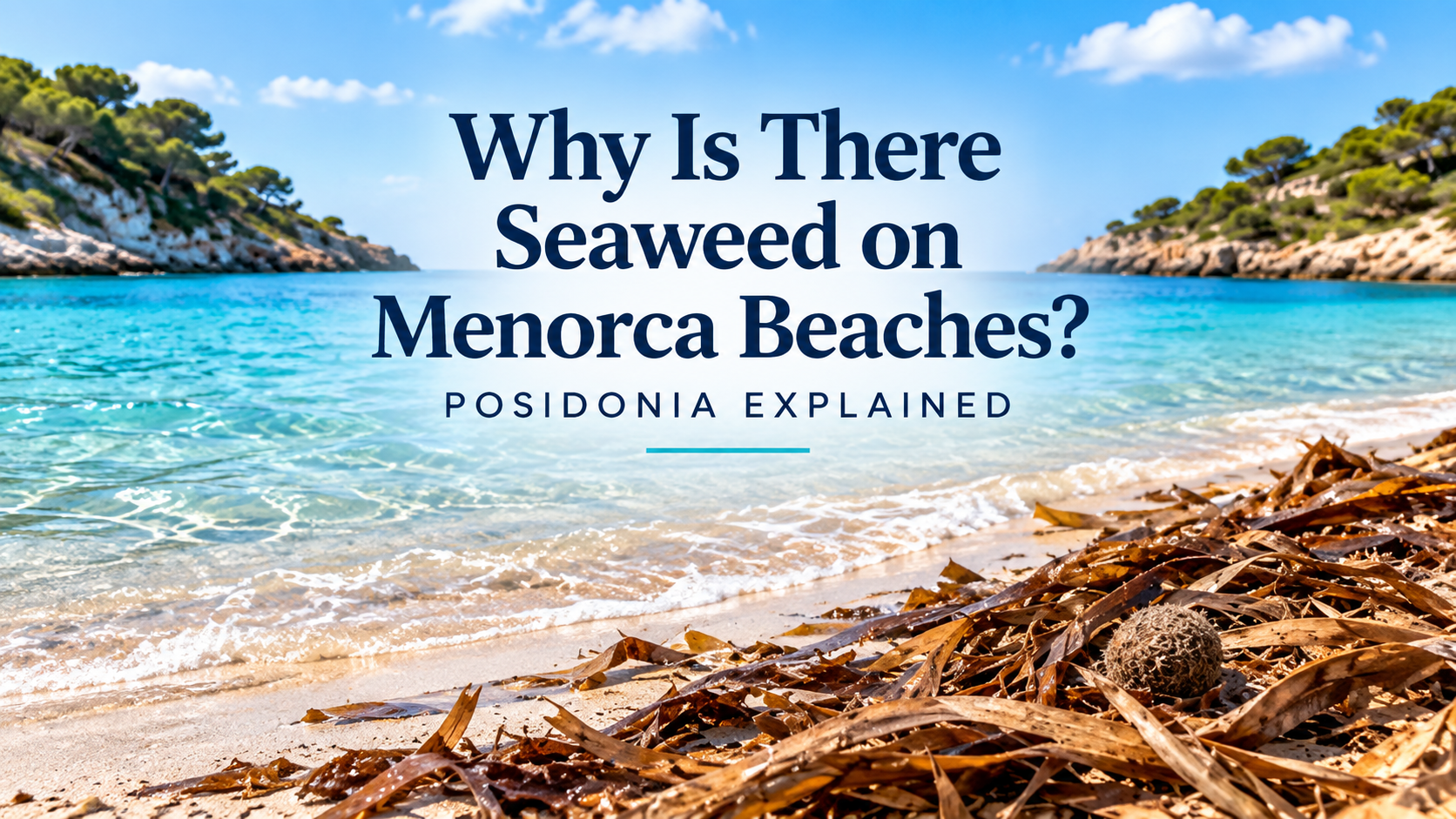
A beach covered with brown leaves can come as a surprise when the photograph that brought you to Menorca showed pale sand and turquoise water. Seaweed on Menorca beaches can make visitors wonder whether the shoreline has been neglected, particularly when another cove visited the previous day appeared completely clear.
What you are seeing, however, may be part of one of Menorca’s most valuable natural systems. Much of the material commonly described as “seaweed” is the remains of Posidonia oceanica, although other marine plants such as Cymodocea nodosa and genuine algae can also wash ashore. Waves, currents and storms move this vegetation between the seabed, shallow water and coastline as part of a normal Mediterranean cycle.
Far from being simply untidy material waiting for somebody to remove it, these deposits help retain sand, soften the impact of waves, support small animals and contribute nutrients to the coastal ecosystem. Understanding why they are there changes the way a natural Menorcan beach looks.
Quick Answers: Posidonia on Menorca’s Beaches
| Question | Answer |
|---|---|
| Is Posidonia seaweed? | No. Posidonia oceanica is a flowering marine plant with roots, rhizomes, leaves, flowers and fruit. |
| Why does it wash onto beaches? | Older leaves are naturally shed and transported ashore by waves, currents and storms, particularly as the plant enters its autumn cycle. |
| Does Posidonia mean a beach is dirty? | No. Beach deposits are a natural part of the coastal ecosystem, although ordinary litter can sometimes become caught among them. |
| Why is it sometimes left on the sand? | The material traps sediment, reduces erosion and helps protect dunes and beaches from waves and storms. |
| Can you swim where Posidonia is present? | The plant itself does not make a beach unsafe for bathing. Always judge swimming conditions from the sea state, official flags and local safety information. |
| Why can it smell? | Wet organic material decomposes naturally and large accumulations can develop a strong smell. This does not automatically mean the water is polluted. |
| Does Posidonia mean the sea is clean? | Healthy underwater meadows are regarded as an indicator of good environmental quality, but leaves on the shore are not a substitute for official bathing-water testing. |
| Can I take it home? | Do not assume you can. Posidonia is protected, and the collection, possession, transport and use of its remains are regulated. |
| Why do some beaches have much more than others? | Nearby meadows, beach orientation, wind, waves, currents and recent storms all influence where leaves accumulate. |
Posidonia Is a Plant, Not an Alga
Posidonia oceanica is endemic to the Mediterranean, meaning this is the only sea in which it naturally occurs. Unlike an alga, it is a flowering plant with roots and rhizomes beneath the seabed as well as long ribbon-like leaves above it. It can also produce flowers, fruit and seeds.
Large underwater meadows develop from shallow coastal areas down to depths determined largely by the amount of light reaching the seabed. Balearic waters allow particularly deep growth because of their transparency, with the Spanish Institute of Oceanography recording lower limits of around 37 metres in some areas.
The plant grows slowly, which is one reason damage can occur much faster than recovery. Its ecological importance has led the European Union to classify Posidonia meadows as a priority habitat under the Habitats Directive, while Spanish legislation gives Posidonia oceanica special protection.
Why Do the Leaves End Up on the Beach?
The brown material along the shoreline usually represents the end of one stage in a natural seasonal cycle rather than the destruction of an underwater meadow. As temperatures begin falling and late-summer and autumn storms arrive, older leaves are shed while new growth develops from the plant below.
Wind, waves and currents then transport the detached vegetation. Some remains move offshore again, while other material collects along the waterline, sometimes forming substantial banks known in coastal science as banquettes or arribazones.
This explains why conditions can change dramatically between visits. A beach that appeared almost clear on Monday may receive a considerable deposit after several days of waves from the right direction, while another cove nearby remains comparatively unaffected.
Autumn visitors may notice larger quantities because this period coincides with natural leaf loss and more unsettled sea conditions. At the same time, fresh underwater development begins, and shallow Balearic meadows may even start flowering from early October.
The Brown Line Is Part of the Beach
Once the leaves reach dry land, their ecological role is not necessarily finished. The material forms a physical barrier capable of absorbing some wave energy and reducing the amount of sand carried away during rough weather.
Spain’s 2026 national legislation covering Mediterranean seagrasses explicitly recognises these deposits as important for limiting coastal erosion, contributing biological sediment and supporting neighbouring environments such as dune systems.
The benefits extend beyond sand retention. Vegetation washed ashore provides shelter for amphipods, isopods, insects and microorganisms, which in turn become food for other animals including birds, beetles and spiders. As the plant matter decomposes, nutrients are also transferred between marine and terrestrial environments.
A mound of dried leaves can therefore function simultaneously as coastal protection, habitat, food source and nutrient store. Removing everything simply because a natural shoreline appears tidier without it can remove some of those benefits as well.
Posidonia Helps Menorca Keep Its Sand
The relationship between Posidonia oceanica and Menorca’s beaches extends beneath the water. Living meadows stabilise marine sediments through their roots and rhizomes, while dense vegetation changes the movement of water close to the seabed.
After leaves reach the shore, they can trap additional sand rather than allowing it to be carried inland or back out to sea. This creates a connection between the underwater meadow, the beach itself and neighbouring dune systems.
That produces an apparent contradiction for tourism. Visitors understandably enjoy uninterrupted stretches of pale sand, yet excessive removal of natural deposits can contribute to the gradual loss of the same shoreline people have travelled to see.
For Menorca, where many coves occupy relatively small coastal systems surrounded by dunes, cliffs or protected countryside, keeping sediment in place is particularly valuable.
Why Doesn’t Menorca Simply Remove It?
Beach cleaning is more complicated than sending machinery along the shoreline every morning. Different beaches receive different forms of management, while authorities have to balance visitor use with erosion, dune protection and conservation.
Menorca has used a differentiated approach in which natural beaches receive considerably less intervention than heavily used urban or resort beaches. Where material is moved from suitable managed shorelines, it can be stored within the same coastal system and subsequently returned rather than treated simply as waste.
The legal framework became stronger in 2026. Real Decreto 191/2026 establishes the general principle that remains of Posidonia oceanica and Cymodocea nodosa should stay on the coast where they arrive whenever possible. Authorised removal can still take place under defined circumstances, particularly on managed tourist beaches, but handling and cleaning methods are restricted.
This is why two beaches may look very different even when they are only a short distance apart. A highly managed urban shoreline may have deposits moved during the bathing season, while a natural cove may retain far more of what the sea has delivered.
Does Posidonia Mean the Water Is Clean?
A healthy living meadow is a positive environmental sign, although that statement needs some care. Posidonia oceanica is sensitive to reduced water transparency, excessive nutrients, pollution and other forms of environmental deterioration, which means scientists can use its condition as an indicator of coastal water quality.
The meadows are also closely associated with the striking clarity of many Balearic coastal waters. They stabilise sediment, trap particles and require enough sunlight for photosynthesis, creating a strong relationship between healthy vegetation and transparent water.
Finding brown leaves on the sand does not, however, certify that bathing water is safe on a particular day. Official water-quality monitoring, pollution warnings, weather and local beach information remain the appropriate sources for that decision.
Posidonia is therefore an ecological indicator rather than a substitute for proper testing.
Is It Safe to Swim Around Posidonia?
Seeing long green ribbons moving beneath the surface can initially feel strange if you are accustomed to swimming over bare sand. The vegetation itself is a normal marine habitat, with fish, invertebrates and many other organisms living among its leaves and rhizomes.
Swimming above a meadow does not damage it in the way that dragging an anchor, chain or heavy equipment through the seabed can. Normal precautions still apply, particularly around waves, currents, jellyfish, boat traffic and beaches without lifeguard supervision.
Floating brown leaves can also accumulate close to shore following rough conditions. Their presence is not, by itself, a reason to consider the water dangerous, although swimmers should always follow official beach flags and local warnings rather than relying solely on appearance.
Why Does Posidonia Sometimes Smell?
Anyone who has encountered a thick, wet accumulation on a warm day knows that Posidonia is not always aesthetically convenient. Once marine vegetation becomes trapped in damp layers and begins decomposing, bacteria and other microorganisms break down the organic material.
That process can produce a distinctive natural odour, particularly where large quantities remain wet for extended periods. Scientific research into Mediterranean beach deposits has identified sulphur compounds associated with decomposition in low-oxygen conditions.
A strong organic smell therefore does not automatically mean that sewage has entered the sea or that the beach is polluted. Genuine pollution concerns should still be taken seriously, but smell alone cannot identify their cause.
Why Does One Menorca Beach Have More Than Another?
There is no fixed Posidonia season in which every shoreline receives an identical amount. Distribution depends partly on where underwater meadows grow and partly on the conditions affecting the coast above them.
A cove facing the direction of recent waves may receive large quantities of plant material, while another protected by the shape of the coastline remains comparatively clear. Wind direction, currents, seabed geography, recent storms and the orientation of each beach can all change the pattern.
Even well-known coves vary from one year to another. Some naturally receive significant accumulations because of their geography, while an unusual sequence of winds or storms may produce substantial deposits somewhere that was relatively clear during the previous season.
The amount lying on the sand therefore tells you far more about natural coastal processes than it does about whether one beach is being maintained better than another.

The Underwater Meadow Matters More Than the Leaves
The material visitors see on dry sand represents only a small and temporary part of a much larger ecosystem. Beneath the surface, living meadows provide feeding areas, shelter and nursery habitat for numerous marine organisms while helping to stabilise the seabed.
Around southern Menorca, several protected marine areas contain particularly extensive Posidonia habitats. The waters south of Ciutadella, for example, include large formations considered important enough to contribute to the area’s Natura 2000 protection.
The waters surrounding Illa de l’Aire provide another example of the biological importance of Menorca’s submerged landscapes. Protected marine habitats there support hundreds of recorded species alongside seagrass and rocky communities.
Most of this remains invisible from a beach towel. Yet protecting what lies beneath the surface is inseparable from preserving the clear water, marine life and coastal scenery that visitors associate with Menorca.
Anchors Are a Bigger Problem Than Swimmers
For boat users, Posidonia requires more active consideration. An anchor dropped into a meadow can uproot plants, while the chain may sweep backwards and forwards across the seabed as a vessel moves with the wind and current.
Spanish legislation now generally prohibits anchoring directly over protected seagrass meadows unless an authorised low-impact system is being used. The Balearic Islands had already introduced protections before the national framework was strengthened in 2026.
The Balearic Government provides dedicated Posidonia mapping to help skippers identify where meadows are located and find appropriate anchoring areas. Checking what lies beneath the boat before dropping an anchor is therefore one of the simplest practical ways visitors can help protect the coastline.
The damage caused by anchoring is particularly significant because the plant develops slowly. A few minutes of careless anchoring can affect vegetation that took many years to establish.
Can You Take Posidonia Home?
Dried leaves, fibrous balls and other pieces washed onto the shore can look like harmless natural souvenirs. Visitors should not assume that substantial quantities can simply be collected and removed.
Posidonia is protected, and Spanish and Balearic regulations control the collection, possession, transport and use of the plant and its remains. The exact rules can depend on circumstances, quantities and purpose, so leaving material where nature has deposited it is the safest approach.
Small children picking up a leaf to examine it is obviously different from loading bags or vehicle boots with beach material. The important point is that natural deposits should not be treated as an unlimited free resource merely because they have reached dry land.
Leaving them behind also allows the sand and nutrients trapped among the leaves to remain within the coastal system.

What Should Visitors Do When They Find Posidonia?
In most circumstances, nothing needs fixing. Treat the material as part of the natural beach rather than assuming somebody has failed to clean it.
Leave substantial deposits where they are, put ordinary rubbish in a bin if it has become trapped among the leaves and avoid removing large quantities from the shoreline. Boat users should anchor over appropriate bare substrate or use authorised moorings rather than dropping equipment into a meadow.
Swimming decisions should be based on actual sea conditions, official flags and local safety information rather than whether vegetation is visible. A perfectly clear beach can still have dangerous water, while a shoreline covered with natural leaves may have calm and safe bathing conditions.
These choices require very little from the visitor, yet they recognise that a Mediterranean beach is a functioning natural environment rather than an outdoor swimming pool.
A Natural Beach Does Not Always Look Manicured
Tourism has created a powerful visual idea of what a perfect beach should resemble: pale sand, transparent water and nothing lying between the towel and the sea. Menorca frequently delivers that image, but nature does not maintain shorelines according to a holiday brochure.
Leaves arrive, storms reshape the coast, dunes move, sand disappears and returns, while vegetation beneath the surface follows its annual cycle. Those processes are part of the reason many stretches of Menorca remain worth visiting in the first place.
The next time a brown line of Posidonia lies between you and the water, it may help to see the scene differently. What initially looks like something spoiling the beach may actually be one of the natural systems helping to keep the beach there.
Research and Methodology
This guide was researched using information from Spain’s Ministry for the Ecological Transition and Demographic Challenge, the Boletín Oficial del Estado, the Govern de les Illes Balears, the Spanish Institute of Oceanography, CEAB-CSIC, EUROPARC and Menorca Biosphere Reserve material.
Particular attention was given to Real Decreto 191/2026, which introduced a common national framework for the conservation of Posidonia oceanica and Cymodocea nodosa meadows in Spanish Mediterranean waters. Beach management can still vary according to classification, conservation status, erosion risk and current local authorisations, so arrangements for a particular location should be checked with the relevant authority when necessary.


