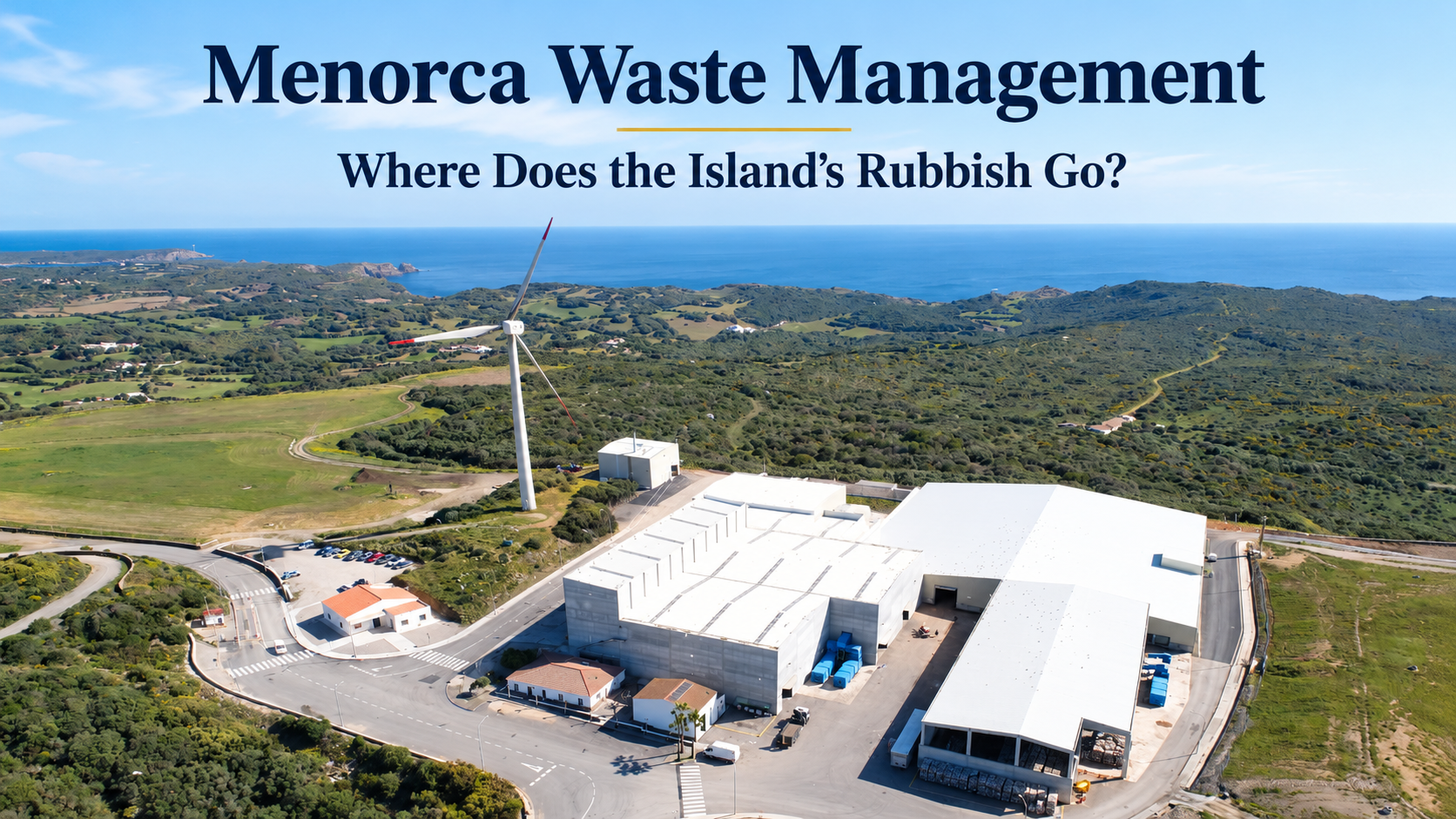
Menorca is getting better at separating its rubbish, yet substantial quantities still end up buried at the island’s landfill. In 2025, 43.6% of waste was reported as directed towards recycling, while the reported landfill disposal share stood at 25.4%. Both figures indicate progress, but they measure different outcomes and Menorca remains some distance from its legal landfill target.
The contrast is particularly striking in Maó, where neighbourhoods using door-to-door collection separated more than 81% of their waste in 2025, compared with 19.9% in areas still using street containers. Yet during the busiest fortnight of August 2026, parts of Menorca’s collection service struggled with overflowing containers and missed collections. Behind these figures is the Milà Environmental Complex near Maó, which sorts and treats waste but must still dispose of a significant residual quantity.
If Menorca is separating more rubbish, why is so much still buried at Milà? Answering that question means following waste beyond the household bin, understanding what the official statistics actually measure and examining what must change before 2030.
Quick Answers: Menorca Waste Management Explained
| Question | Answer |
|---|---|
| Where does Menorca’s rubbish go? | Waste follows different routes after collection. Milà is the principal municipal treatment complex, while some recyclables and specialist wastes go to facilities elsewhere. |
| Does Menorca have a landfill? | Yes. The Milà complex near Maó includes the island’s controlled landfill for residual material requiring disposal. |
| What happens at Milà? | Mechanical sorting, biological and organic treatment, recycling preparation, leachate management, specialist incineration and controlled landfill disposal. |
| How much waste does Menorca recycle? | The 2025 assessment reported 43.6% directed towards recycling. This is not necessarily the proportion ultimately recycled into new materials. |
| How much goes to landfill? | Approximately 28,600 tonnes in 2025, with a reported landfill disposal share of 25.4% under the annual assessment’s methodology. |
| Is separate collection improving? | Yes. Collections of organic waste, packaging, paper and cardboard increased in 2025, while mixed residual waste declined. |
| What is door-to-door collection? | Households present different waste categories according to a collection schedule instead of relying entirely on communal containers. |
| Does every town use the same system? | No. Household and commercial arrangements differ between municipalities and sometimes between neighbourhoods. |
| Why were there problems in August 2026? | Peak demand coincided with staffing gaps, vehicle breakdowns, some missed collection frequencies and insufficient container capacity. |
| Is everything recycled on Menorca? | No. Significant quantities of paper, glass and sorted packaging travel to specialist processors in Mallorca or mainland Spain. |
| Does Milà incinerate household rubbish? | No general municipal-waste incinerator operates there. The existing incinerator handles particular specialist waste streams. |
| What is the 2030 landfill target? | Balearic legislation requires landfill disposal to fall to no more than 10% before 2030, under the applicable legal definition. |
The central distinction is between collecting material separately and successfully recycling it. Even correctly sorted waste must be transported and processed, and some material will remain unsuitable for recovery.
Where Does Menorca’s Rubbish Actually Go?
Rubbish from households, hotels, restaurants and shops is collected through municipal or commercial services, using door-to-door rounds, communal containers and dedicated collection points. The route then depends on the material: glass, paper, packaging, food waste and mixed residual rubbish do not all enter the same treatment process.
Milà is the main hub for Menorca’s municipal waste treatment. Mixed rubbish can undergo mechanical and biological processing, packaging is sorted for recovery, and separately collected organic material receives biological treatment. Recyclable fractions may leave the island for specialist processing, while treatment rejects and material without a suitable recovery route require authorised disposal.
| Stage | What happens |
|---|---|
| Collection | Materials are gathered separately where possible, or in the mixed residual stream. |
| Sorting | Recyclables are separated and unsuitable or contaminated material is identified. |
| Treatment | Organic waste undergoes biological processing; other fractions follow their appropriate routes. |
| Onward processing | Prepared recyclables are sent to specialist facilities, including destinations outside Menorca. |
| Disposal | Material that cannot be recovered is deposited in controlled landfill where authorised. |
This is a simplified journey rather than one production line through which every bag passes. Bulky items, electrical equipment, hazardous substances and construction waste require different services and authorised management routes.
How Much Waste Does Menorca Produce?
The latest complete annual assessment available in October 2026 covers 2025. The Consorci de Residus i Energia de Menorca reported approximately 57,500 tonnes collected through the services covered by one published collection dataset, of which around 19,427 tonnes were collected as identified separate fractions.
The wider annual assessment uses additional indicators with different reporting boundaries and denominators. Its recycling-related and landfill percentages therefore cannot simply be added together or subtracted from 100% to identify the remainder.
| Indicator | Reported 2025 position |
|---|---|
| Waste in the published collection dataset | Approximately 57,500 tonnes |
| Separately collected material in that dataset | Approximately 19,427 tonnes |
| Waste directed towards recycling | 43.6% |
| Landfill disposal share | 25.4% |
| Waste disposed of in landfill | Approximately 28,600 tonnes |
| Increase in separately collected organic waste | 32.94% |
| Increase in separately collected lightweight packaging | 14.12% |
| Increase in separately collected paper and cardboard | 9.49% |
| Reduction in mixed residual waste collection | 3.27% |
Source: Consorci de Residus i Energia de Menorca, 2025 annual assessment and related collection statistics. Different indicators do not necessarily use the same denominator.
The increase in separately collected materials is encouraging, particularly given the reduction in mixed residual rubbish. However, material directed towards recycling is not necessarily identical to material successfully recycled, because sorting and processing can generate rejects.
Earlier local reporting described landfill disposal as approximately 42% of generated waste in 2024, with 31,081 tonnes deposited. The 2025 physical quantity fell to approximately 28,600 tonnes, around 7.9% lower, but the reported 42% and 25.4% figures should not be treated as a directly comparable year-on-year percentage series without establishing that they share the same accounting method.
Menorca Does Not Have One Rubbish Collection System
Collection arrangements vary across the island. Maó and Es Castell have introduced household door-to-door services, known as porta a porta, which require residents to present different fractions on designated days. Some rural properties and less accessible locations still use collection points, while conventional street containers remain important elsewhere.
Commercial services add another layer. Door-to-door business collections operate in Ciutadella, Ferreries, Es Mercadal, Es Migjorn Gran, Alaior and Sant Lluís, including premises producing substantial quantities of packaging, glass and food waste. A hotel’s arrangements may therefore differ from those of a neighbouring household.
For residents and property owners, collection schedules and accepted materials must be checked locally. There is no single island-wide set of bins or collection days, and differences between household and commercial systems affect the statistics reported for each municipality. Second-home owners should pay particular attention to the arrangements for their specific street or development, rather than assume that the system used in a neighbouring town applies to them.
Why Door-to-Door Collection Has Changed the Numbers
Maó provides unusually clear evidence of the effect of collection arrangements. During 2025, its door-to-door areas separated more than 81% of collected rubbish, compared with just 19.9% in areas retaining conventional street containers. The municipality-wide selective collection rate rose from 40% in 2024 to 48.8% in 2025, while mixed residual rubbish fell by more than 1,000 tonnes.
| Maó separate collection indicator | Result |
|---|---|
| Municipality-wide, 2024 | 40.0% |
| Municipality-wide, 2025 | 48.8% |
| Door-to-door collection areas, 2025 | More than 81% |
| Conventional street-container areas, 2025 | 19.9% |
Source: Official Menorca waste-collection service, 2025 results published in 2026.
The 81% and 19.9% figures refer to different groups of neighbourhoods, not competing estimates for Maó as a whole. The municipality-wide rate of 48.8% is therefore the appropriate figure to compare with the previous year’s municipal result.
Es Castell also recorded substantial gains after introducing household door-to-door collection across the municipality. Its separate-collection rate increased from approximately 65% in 2024 to almost 78% in 2025, while the mixed residual fraction fell by 334 tonnes. These figures measure separation at collection, not the final proportion converted into recycled products.
Better Results, but Practical Difficulties
The collection method also changes daily routines. Households must store fractions between scheduled collections, and large apartment buildings need workable arrangements for shared space, containers and presentation times. Maó has experienced complaints and instances of mixed rubbish left outside the authorised system, requiring additional collection vehicles.
The eighth stage of Maó’s rollout began in May 2026, while the remaining Ses Vinyes and Avinguda Menorca areas were scheduled for inclusion towards the end of November. That final stage was still planned as of October 2026, rather than completed. The evidence supports door-to-door collection as a way to improve separation, but those results should not be confused with universal public acceptance or flawless operation.
What Happened During August 2026?
Despite the improvement in annual recycling-related statistics, collection services came under pressure during the busiest part of summer 2026. Overflowing recycling containers were reported particularly in Alaior and Es Mercadal, including developments where seasonal occupation rises sharply.
On 5 September, the Consell acknowledged that the system had been overwhelmed in some areas during the fortnight of highest occupancy. Officials identified staff absences that could not be covered, vehicle breakdowns and failures to maintain some collection frequencies. The number of containers also proved insufficient in certain locations.
Es Mercadal had requested additional recycling containers, but the Consell said the available stock was limited. Improper disposal, including bulky rubbish abandoned at collection points and businesses using containers not intended for them, added pressure to an already stretched service.
The Consell was reviewing the contractor’s performance and examining whether contractual obligations had been fulfilled. It also outlined new collection arrangements intended to improve reliability before summer 2027, together with additional container capacity. These were investigations and proposals at the time, not confirmed findings of a breach or improvements already delivered.
August’s difficulties were linked to seasonal demand, but they were not caused by tourism alone. Collection frequency, staffing, vehicles, contracts and the behaviour of different users all influence whether a service can cope with periods of peak occupancy.
What Is the Milà Environmental Complex?
The Milà Environmental Complex near Maó is much more than a rubbish dump. Operated by UTE Es Milà under arrangements with the Consorci, it brings together the treatment and disposal operations required for much of Menorca’s municipal waste.
The complex contains mechanical sorting equipment for mixed rubbish and packaging, biological treatment for suitable material, organic-waste and composting facilities, preparation areas for recyclable fractions, leachate treatment and a controlled landfill. Materials such as plastics, metals, beverage cartons and some paper can be separated before being sent to specialist recyclers.
Organic material follows a different route. Separately collected food and green waste can be treated biologically to produce an appropriate compost product, while organic matter recovered from mixed rubbish may result in a different stabilised material with different permissible uses. The quality and destination of these outputs depend on contamination, treatment and applicable standards.
Does Milà Have an Incinerator?
Milà does have an incinerator, but it is intended for specified animal-derived and sanitary waste streams rather than ordinary municipal rubbish. Its published design capacity is approximately 500 tonnes annually, making it fundamentally different from any proposed general waste-incineration facility.
The complex also manages landfill gas and leachate, the contaminated liquid that can develop as water passes through deposited material. These systems are essential environmental controls for an operating treatment complex and controlled landfill.
What Happens to Menorca’s Recycling?
Putting material into a recycling container is only the first stage of its recovery. Paper, glass and packaging require sorting and specialist industrial processing, and Menorca does not have facilities to turn every recovered material into a new product. Significant quantities therefore leave the island.
| Material | Route after collection |
|---|---|
| Paper and cardboard | Prepared and sent to specialist paper recyclers, including facilities on the mainland. |
| Glass | Collected separately and transported to specialist glass-processing facilities, including Mallorca. |
| Lightweight packaging | Sorted into plastics, metals and cartons, then sent to appropriate recycling processors. |
| Food and organic waste | Biologically treated at Milà, subject to quality and contamination controls. |
| Mixed residual rubbish | Mechanically treated where appropriate; recoverable material is extracted and remaining rejects managed or landfilled. |
| Textiles and electrical equipment | Collected through dedicated services and recycling centres for authorised reuse or specialist treatment. |
| Bulky items and construction waste | Taken through recycling centres or authorised waste managers according to material and condition. |
These are general treatment routes, not a guarantee that every item placed in a given container is ultimately recycled.
The quantities moved off-island are substantial. During 2025, approximately 4,860 tonnes of paper and cardboard were sent to Saica’s facilities in Zaragoza, around 3,845 tonnes of glass went to a processor in Mallorca, and roughly 1,914 tonnes of sorted lightweight packaging were dispatched to specialist destinations.
In March 2026, the Consorci also reported stocks of packaging and paper awaiting onward processing, citing difficulties in the wider recycling market. Those stockpiles illustrate a constraint beyond household behaviour: collection and sorting are only useful when transport and processing capacity are available.
The Consorci reported more than €3.2 million in 2025 income associated with separate collection, recycling preparation and recovered materials. That helps support the system, but should not be mistaken for profit once collection, treatment, staff and transport costs are considered.
Why Does Waste Still Go Into Landfill?
Residual waste includes materials left mixed together by households and businesses, items without a suitable recovery route and rejects from sorting or biological treatment. Milà can extract some recoverable material from mixed rubbish, but it cannot convert every contaminated or unsuitable product into a resource.
The 2025 assessment reported approximately 28,600 tonnes disposed of in landfill and a landfill share of 25.4% under its reporting methodology. The physical tonnage was around 7.9% below the 31,081 tonnes reported for 2024, but it remained far above what would be compatible with the Balearic objective of no more than 10% before 2030.
Why Landfill Cells Matter
A controlled landfill is divided into engineered cells, each with an authorised capacity and environmental safeguards. An available location to deposit waste therefore depends on completed construction, regulatory permission and operational readiness, not simply vacant land.
This became an immediate issue at Milà in early 2026. In February, reporting described subcell 2.2.B as having reached its limit while authorisation for the next cell, 2.1, was pending. The new cell, with a capacity of approximately 70,000 tonnes, had entered operation by June after the authorisation issue was resolved.
Opening that cell provided additional capacity but did not change the statutory requirement to reduce landfill disposal. Capacity planning and waste reduction remain connected, yet distinct, responsibilities.
Fires were reported at Milà in May and July 2026, affecting approximately 300 square metres and 50 square metres of accumulated waste respectively. Emergency teams brought both incidents under control, and they warrant attention as operational risks requiring appropriate monitoring and procedures. The incidents do not, by themselves, establish that the complex as a whole is unsafe.
Food and Organic Waste: Better Collection, Treatment Pressures
Separately collected organic waste is one of Menorca’s fastest-improving categories. Approximately 5,301 tonnes were collected in 2025, an increase of 32.94% on the previous year, helped by the expansion of household and commercial door-to-door services.
Keeping food scraps and suitable biodegradable material out of mixed rubbish makes treatment easier and can produce useful compost. However, ordinary plastic bags and other contamination create difficulties, and separately collected organic waste must be distinguished from organic matter mechanically extracted from mixed rubbish, which can have different treatment outcomes and permitted uses.
Milà’s organic-treatment operation experienced problems in 2026. In June, the Consorci initiated contractual penalty proceedings over reported deficiencies affecting organic and green-waste processing, with a proposed penalty of €60,000. Reports identified delays, accumulated material and departures from required operating arrangements, with approximately 200 tonnes awaiting processing at one stage.
The operator pointed to plastic contamination and staffing difficulties, while the Consorci sought corrective measures. Separately, local reporting indicated that finished compost was awaiting certification before it could be sold as fertiliser. The initiation of penalty proceedings must not be presented as a final legal finding, and the increase in collected organic waste should not be confused with proof that all of it had been successfully converted into marketable compost.
Tourism and the Seasonal Waste Challenge
Menorca’s infrastructure serves far more people during its busiest months than its permanent resident population suggests. Hotels, restaurants, second homes and seasonal businesses generate additional food waste, glass, cardboard, packaging and mixed rubbish, while collection vehicles must make more frequent rounds in heavily occupied areas.
The geographical pattern matters as much as the island-wide total. Coastal developments that are quiet in winter can fill rapidly in summer, creating concentrated demand at communal containers, while commercial districts may generate large quantities of particular waste fractions.
Human-pressure statistics help explain when these peaks occur, but they do not directly measure how much rubbish tourists produce. Dividing annual waste tonnage by the registered resident population alone can also obscure the number of seasonal users. Isolating the visitor contribution would require compatible local collection and activity data, and the August failures already described also reflected service capacity and operational factors.
Reducing unnecessary packaging, preventing food waste and improving commercial separation can help limit the load before collection begins. These measures are relevant to residents and businesses throughout the year, as well as to the tourism industry.
What About Waste on Beaches and the Coast?
Coastal litter is another visible part of Menorca’s waste problem, although it is measured separately from municipal household and commercial collections. The Balearic coastal-cleaning service reported removing approximately 1,138 kg of waste from Menorca’s coastal waters during August 2026, while plastics represented the largest recorded material category across the Balearic Islands.
During summer 2026, the Consell also introduced separate residual-waste and packaging containers on eleven beaches, including Cala Galdana, Son Bou, Arenal d’en Castell, Punta Prima and Cala en Porter. The initiative aimed to make separation easier in heavily visited coastal areas.
Neither figure establishes the total amount of rubbish entering Menorca’s marine environment. Coastal-cleaning results depend on the area and method of collection, and should not be added to municipal-waste statistics as though they measure the same activity. Natural Posidonia leaves washed onto Menorca’s beaches should not be confused with ordinary litter, as they form part of the coastal ecosystem.
Can Menorca Meet Its Waste Targets for 2030?
Balearic Law 8/2019 requires landfill disposal to fall to a maximum of 10% before 2030, under the applicable legal definition. The timing is more demanding than the comparable EU-wide 10% objective for 2035, and Menorca’s reported 2025 landfill share of 25.4% indicates the size of the remaining challenge.
The legal framework also establishes objectives for prevention, recycling and preparation for reuse. These require separate measurement because a rise in material collected for recycling does not automatically demonstrate that the equivalent quantity has been recycled.
| Measure | Meaning |
|---|---|
| Waste generation | Total waste produced under a defined reporting method. |
| Separate collection rate | Share gathered in identified material categories rather than as mixed rubbish. |
| Recycling rate | Share actually processed through qualifying recycling operations. |
| Recovery rate | Material or value recovered through qualifying operations, potentially including more than material recycling. |
| Landfill rate | Quantity deposited in landfill relative to the denominator required by the relevant rules. |
These indicators explain why the 43.6% recycling-related figure and the 25.4% landfill figure must not be treated as opposite sides of one calculation. A credible assessment of progress needs the underlying tonnages, definitions and processing outcomes. Lower disposal can result from producing less waste as well as recovering more of what is collected, so trends in generation and recycling must be evaluated together.
Could Menorca Build a General Waste Incinerator?
In May 2026, the Consell acknowledged the difficulty of meeting the landfill deadline and said different treatment options were under examination. Possibilities discussed included a larger municipal-waste incinerator and transporting residual waste elsewhere for treatment, including potential arrangements involving Mallorca.
Both approaches present questions of cost, transport logistics and environmental impact. A new facility would need formal planning, environmental assessment, approvals and financing, while shipping residual material off-island would create an ongoing logistical dependency.
No general municipal-waste incinerator had been approved for construction in the developments described, and suggestions that legal deadlines might change were not changes to the law. Milà’s existing specialist incinerator is a separate, much smaller installation and should not be presented as an existing solution for ordinary municipal rubbish.
What Needs to Change?
Menorca’s 2025 results show that better separation is achievable, but collection is only one part of the system. Progress towards 2030 depends on preventing waste, improving the reliability of collection, reducing contamination, securing genuine recycling outcomes and limiting what finally enters landfill.
Five measurable tests would provide a useful basis for judging whether those changes are working, rather than relying on headline percentages alone. They would also show whether improvements in one part of the system create new pressures elsewhere.
| Priority | What should be measured? |
|---|---|
| Waste prevention | Total waste generated under consistent definitions, interpreted alongside seasonal population pressure. |
| Collection quality | Separate collection, contamination, missed rounds and performance across municipalities. |
| Actual recycling | Material accepted into qualifying recycling processes, with rejects and stockpiles accounted for. |
| Organic treatment | Material processed, delays, contamination, final product quality and authorised uses. |
| Landfill dependence | Tonnes deposited, the legally defined disposal share and remaining authorised cell capacity. |
In the nearer term, important developments include Maó’s planned final door-to-door rollout, the proposed changes to collection arrangements following August’s failures, and corrective action concerning organic treatment at Milà. The next annual assessment should also show whether the reduction in landfill tonnage continued beyond 2025.
Menorca’s waste challenge is not simply persuading more people to put rubbish in the correct container. It is reducing the quantity produced, recovering useful materials after separation and progressively cutting what must ultimately be buried at Milà. The strongest evidence of success will be reliable collection, verified recycling outcomes and a sustained fall in landfill disposal, not merely the expansion of collection schemes.
Research and methodology note: This article reflects information available on 13 October 2026. It draws on the Consorci de Residus i Energia de Menorca’s 2025 reporting, the official Menorca collection service, published information about the Milà Environmental Complex, Balearic waste legislation and documented local reporting. Collection, recycling, recovery and landfill indicators are distinct measures and may have different denominators. Contractual investigations, proposed infrastructure and future collection stages are described according to their documented status, not assumed outcomes.