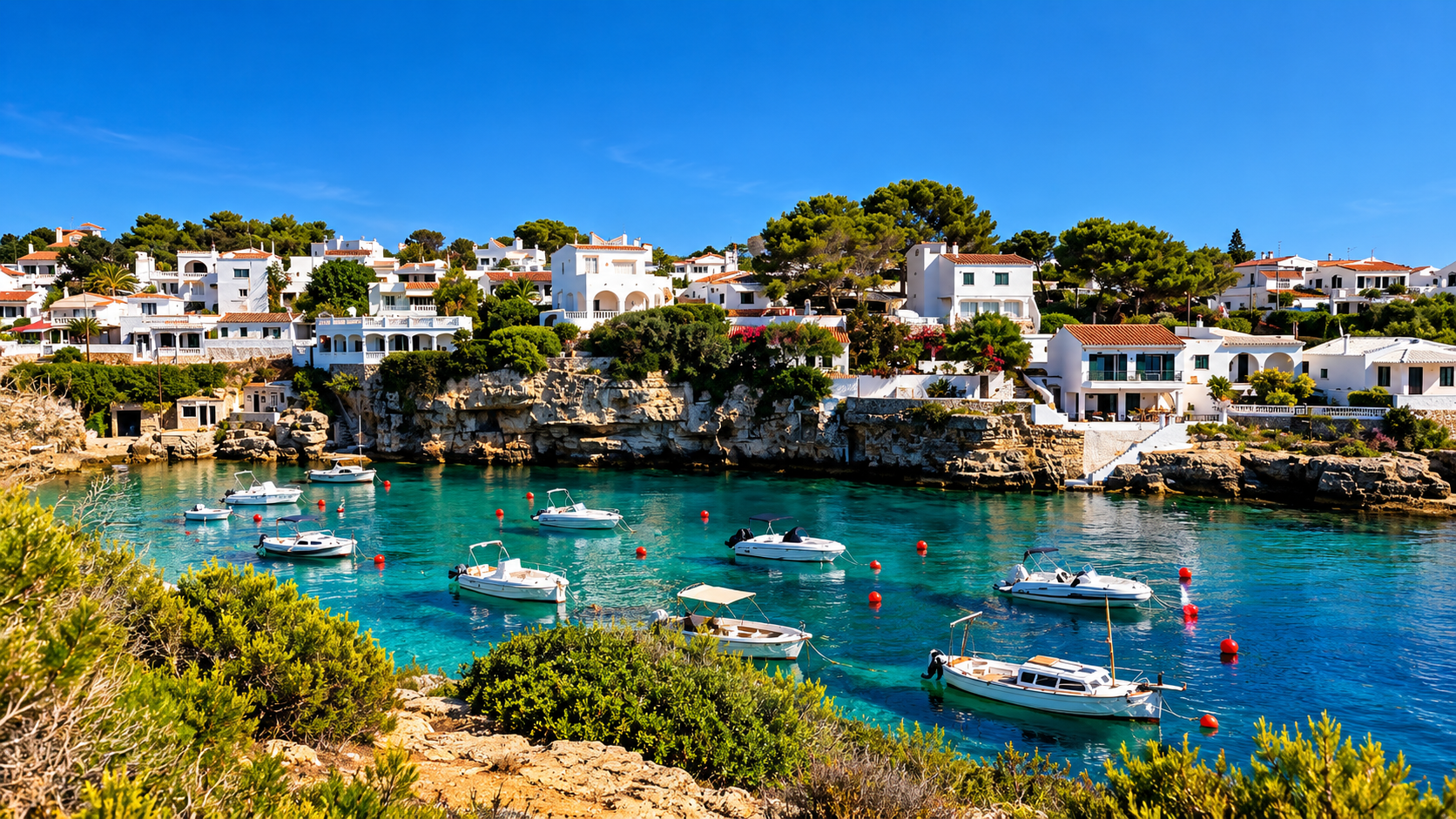
Menorca’s holiday rental market in 2026 is defined by restriction, regulation and a clear shift away from expansion.
New licences remain frozen, enforcement has intensified, and both local and national rules now shape how properties can be rented legally. At the same time, public sentiment on the island has moved towards protecting housing, limiting tourism pressure and maintaining long-term balance.
This is no longer a market driven by growth, but one being carefully controlled.
A market shaped more by restriction than growth
The defining feature of Menorca’s rental market is not demand, but limitation.
Following the approval of Decree-Law 4/2025, the Balearic Government has reinforced a framework designed to contain tourist accommodation rather than expand it. The intention is not simply to regulate the market, but to reduce pressure on housing and infrastructure while preserving the island’s overall balance.
Menorca remains under an active moratorium that prevents the creation of new tourist rental licences. This position is expected to continue until the Consell Insular completes its long-awaited study into the island’s carrying capacity, which will determine how many tourist places can exist sustainably.
In practical terms, supply is no longer open-ended. It is being deliberately capped. These measures form part of a wider regulatory framework set by the Balearic Government, which continues to prioritise housing stability and tourism control across the islands.
The ongoing moratorium is managed at island level by the Consell Insular de Menorca, which is responsible for defining long-term capacity limits
A structural shift away from apartment-based rentals
One of the most significant changes is the effective removal of new tourist rentals in apartment buildings.
Under current rules, properties within multi-family buildings can no longer obtain new licences. This marks a clear departure from the model seen in many other European destinations, where apartment conversions have driven rapid growth in short-term rental supply.
In Menorca, the direction is different.
Future eligibility, where it exists at all, is expected to focus on detached or semi-detached homes. The result is a more dispersed, lower-density rental landscape that aligns with the island’s broader planning philosophy.
This is not a temporary measure. It represents a long-term repositioning of how tourism accommodation is structured.
National rules now sit alongside regional control
In addition to Balearic regulation, a new national requirement has added another layer of oversight.
From mid-2025, all tourist rental properties listed on online platforms must be registered in Spain’s National Tourist Accommodation Registry and display a Unique Registration Number. This measure, introduced under EU Regulation 2024/1028, is designed to improve transparency and standardise data collection across member states.
Importantly, this does not replace the existing Balearic licence system.
Property owners must now comply with both frameworks. Listings on platforms such as Airbnb or Booking must display valid registration details, and failure to do so places the listing outside the legal market.
The result is a system where oversight operates at multiple levels, reducing the scope for informal or unregulated activity.
Enforcement is no longer theoretical
Alongside tighter regulation, enforcement has become more visible and more consequential.
Fines for illegal holiday rentals in the Balearic Islands now reach as high as €500,000 in serious cases, with lower-tier penalties still significant enough to deter non-compliance. Renting without a licence, operating in restricted areas, or failing to meet registration requirements can all result in substantial financial consequences.
At the same time, responsibility is no longer limited to property owners.
Digital platforms are now required to display licence numbers, and listings without them are considered illegal. This shifts part of the compliance burden onto the platforms themselves, closing gaps that previously allowed unlicensed properties to operate more easily.
There is also a longer-term mechanism being introduced. Properties that remain inactive, with no declared tourist activity or tax contributions over several years, will be removed from the registry. This prevents licences from being held without use and limits speculative accumulation.
This short‑term rental environment sits within a wider framework of how Menorca is expected to function over the next decade, explored in more detail in Menorca 2030 and the island’s sustainability trajectory.
A broader effort to contain tourism pressure
These changes do not exist in isolation.
They form part of a wider effort across the Balearic Islands to control the scale and impact of tourism. In Menorca, this aligns closely with an already cautious approach to development.
The continued restriction on new tourist apartments reinforces a direction that prioritises lower-density accommodation and avoids rapid expansion. Political focus has been less about encouraging growth and more about managing existing capacity.
This approach reflects the same balance discussed in why Menorca feels different, where restraint plays a central role in shaping the island’s character.
Local attitudes are shifting, but not uniformly
The conversation around holiday rentals on the island is more nuanced than simple support or opposition.
There is a growing awareness among residents of the impact that tourism can have on housing availability, infrastructure and the overall character of the island. This has led to increased support for measures that limit disruption and protect long-term stability.
At the same time, there are concerns from property owners and smaller operators.
Some rely on seasonal rentals as part of their income, and rapid regulatory changes can create uncertainty. There are also concerns that overly restrictive systems may push activity underground or make compliance disproportionately complex for smaller participants.
What is clear is that the island is moving towards a model that prioritises balance, even if the path to that balance is still being defined.
What this means for Menorca’s holiday rental market in 2026
The result of these combined pressures is a market that looks very different from just a few years ago.
Volume is no longer the defining factor. Instead, the focus has shifted towards compliance, quality and long-term sustainability.
Legally compliant properties, particularly those that meet current structural requirements, are likely to remain in demand. At the same time, opportunities for new entrants have become far more limited, especially in the apartment sector.
The market is becoming more controlled, more professional and less speculative.
A shift in direction rather than a temporary phase
What is happening in Menorca is not a short-term correction.
It reflects a broader repositioning of the island’s relationship with tourism. Growth is no longer the central objective. Stability, environmental protection and social balance are taking precedence.
This has implications not only for property owners, but for how the island is experienced more generally. It also connects to broader questions about how the island functions, explored in is Menorca worth it.
A more controlled future
Menorca’s holiday rental market in 2026 is defined by regulation, responsibility and a clear sense of direction.
With strict enforcement, limited new supply and a growing emphasis on sustainability, the island is shaping a model that places long-term balance ahead of rapid expansion.
For visitors, this often results in a more stable and predictable environment. For owners and operators, it creates a framework that is more demanding, but also more clearly defined.
The shift is already underway, and it is unlikely to reverse.
Common questions about Menorca’s holiday rental market
Can you still buy a property in Menorca for holiday rental?
Yes, but the ability to rent it legally depends on strict licensing rules. New licences are currently restricted, particularly for apartments, and buyers need to understand the regulatory environment before making decisions.
Are new holiday rental licences still being issued in Menorca?
No. A moratorium is currently in place, which prevents the creation of new licences until the island’s tourism capacity limits are reassessed.
Are holiday rentals being banned in Menorca?
No, but they are being tightly controlled. The focus is on limiting new supply, enforcing compliance and reducing pressure on housing rather than removing the sector entirely.
What happens if you rent without a licence in Menorca?
Operating without a valid licence can lead to significant fines and the removal of listings from major platforms. Enforcement has increased, and compliance is now taken more seriously.
Will the rental market expand again in the future?
Expansion is unlikely in the short term. The direction of policy suggests a continued focus on limiting growth and maintaining balance rather than increasing capacity.