Caldereta de Langosta is Menorca’s signature seafood dish, originating in the fishing village of Fornells. Prepared with Mediterranean spiny lobster, tomatoes, onions, garlic, peppers and olive oil, it represents centuries of Menorcan maritime tradition. Authentic Caldereta is celebrated for its simple ingredients, rich broth and deep connection to the island’s culinary heritage.
There are certain dishes that become inseparable from the places where they were born.
Bouillabaisse belongs to Marseille. Paella belongs to Valencia. Bouillabaisse would lose part of its identity if served anywhere else, because it tells the story of a particular coastline, a particular fishing community and a particular way of life.
Caldereta de Langosta occupies that same position in Menorca.
To describe it simply as a lobster stew is to miss almost everything that makes it remarkable. It is the culmination of centuries of maritime tradition, shaped by the waters surrounding the island, by generations of fishermen who understood the Mediterranean intimately, and by a culture that has always believed the finest ingredients require the least intervention.
Today, Caldereta de Langosta is recognised as Menorca’s signature dish. Visitors travel specifically to experience it, restaurants proudly display it as the centrepiece of their menus, and its reputation extends far beyond the Balearic Islands. Yet its origins are surprisingly humble. This was never intended to be a luxury meal. It was born from practicality, necessity and an intimate understanding of the sea.
Understanding Caldereta means understanding Menorca itself.
The dish reflects everything that defines the island: respect for nature, patience, craftsmanship, simplicity and an unwavering confidence that exceptional ingredients should speak for themselves.
Unlike many celebrated recipes that have changed dramatically over time, authentic Caldereta remains remarkably faithful to its origins. Modern chefs may refine techniques or presentation, but the soul of the dish has altered very little over the centuries. The same essential ingredients continue to appear in kitchens throughout the island. Fresh lobster, ripe tomatoes, onions, garlic, peppers, olive oil and good stock remain its foundation, just as they were for the fishermen who first prepared it.
Its enduring popularity is not driven by fashion or nostalgia. It survives because it represents something increasingly rare in modern cuisine: authenticity.
Why Caldereta de Langosta Became Menorca’s Signature Dish
Every region possesses foods that local people cherish but which remain relatively unknown elsewhere. Others become symbols recognised around the world.
Caldereta belongs firmly to the second category.
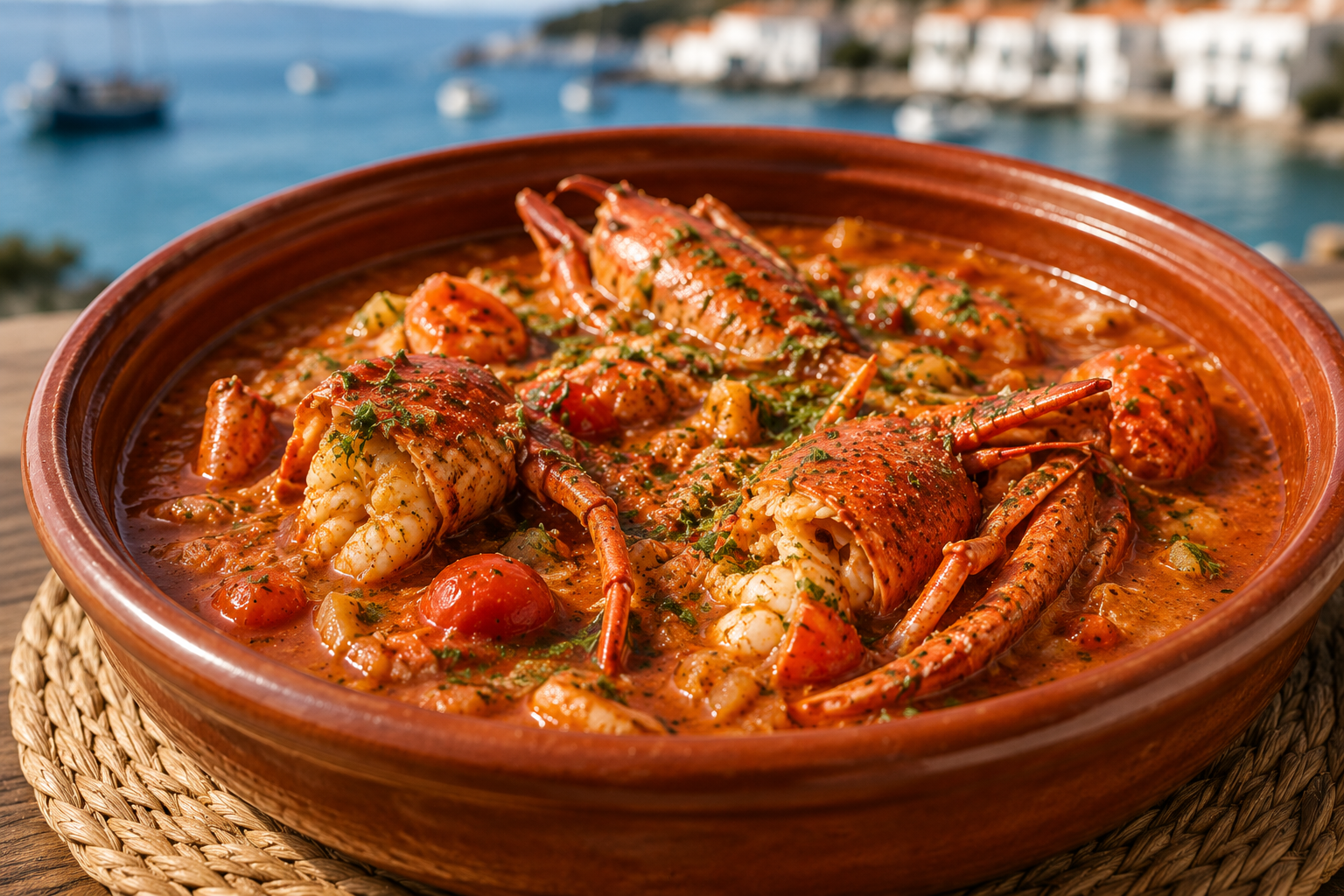
For many visitors, their first introduction to Menorcan cuisine begins with photographs of a large terracotta dish containing vibrant red lobster resting in a fragrant tomato-based broth, served alongside thick slices of rustic bread. Restaurants overlooking the harbour in Fornells have become synonymous with this image, but the dish’s reputation stretches far beyond that picturesque fishing village.
It appears in travel guides, culinary magazines, television documentaries and international food writing as one of Spain’s great seafood dishes.
Yet its fame has not been manufactured.
Unlike recipes created for tourists, Caldereta earned its reputation organically. Its status grew because travellers who experienced it returned home talking not simply about the taste, but about the entire experience surrounding the meal.
Eating Caldereta is rarely rushed.
The lobster is usually selected according to size before cooking begins. Preparation takes time because every stage, from developing the sofrito to gently simmering the broth, requires patience. Diners often spend hours around the table, sharing conversation while breaking apart shellfish, dipping bread into the broth and enjoying local wine.
In many respects, the experience reflects the rhythm of Menorca itself.
Life on the island has traditionally moved at a gentler pace than on mainland Spain. Meals have always been occasions rather than interruptions. Caldereta encourages exactly that philosophy.
Perhaps this explains why so many visitors remember not only the dish, but also the afternoon or evening during which they ate it.
Food becomes memory.
Memory becomes tradition.
Tradition becomes identity.
Menorca’s Relationship With the Sea
Looking at a map of Menorca, it becomes immediately obvious why seafood occupies such an important place in the island’s cuisine.
Although covering only around 700 square kilometres, Menorca possesses more than 280 kilometres of coastline. Bays, coves, natural harbours and rocky headlands define almost every part of its geography.
For thousands of years, the sea has provided food, employment and protection.
Long before tourism became the island’s principal economic driver, fishing sustained entire communities. Small ports developed around natural inlets where boats could shelter from winter storms. Families passed knowledge between generations, learning how winds, currents and lunar cycles influenced different species throughout the year.
Fishing was never simply an occupation.
It was an understanding of place.
The Mediterranean surrounding Menorca differs significantly from the Atlantic Ocean. Its waters are generally warmer, clearer and less nutrient-rich. These conditions produce fish and shellfish with distinctive characteristics, often subtler and sweeter than their Atlantic counterparts.
The rocky northern coastline, continually shaped by the powerful Tramuntana wind, provides an ideal habitat for one of the Mediterranean’s most prized inhabitants: the European spiny lobster.
Without these underwater landscapes, Caldereta would never have existed.
The Mediterranean Spiny Lobster Is Unlike Any Other
Visitors familiar with North American lobster are often surprised when they first encounter Menorca’s native species.
The Mediterranean spiny lobster (Palinurus elephas) bears little resemblance to the clawed lobsters commonly found in the Atlantic.
Its most striking features are its extraordinarily long antennae, heavily armoured shell and complete absence of large front claws.
At first glance, it almost appears prehistoric.
Its body is protected by rows of sharp spines that discourage predators, while powerful abdominal muscles allow rapid backward escape movements whenever danger approaches.
The lack of claws changes almost everything about its culinary character.
Atlantic lobsters carry a significant proportion of their meat within the claws. Mediterranean spiny lobsters concentrate almost all of their edible flesh inside the tail and body.
The result is meat with a noticeably firmer texture and an intensely sweet flavour that many chefs consider superior for broth-based dishes.
Because the shell contains comparatively little edible flesh outside the tail, every part of the animal assumes greater importance during cooking.
The head, body cavity and shell all contribute remarkable flavour when gently simmered.
Discarding them would mean losing much of what makes Caldereta exceptional.
Life Beneath Menorca’s Waters
The European spiny lobster spends much of its life hidden from view.
Unlike species that burrow into sand or mud, it favours rocky underwater landscapes where cracks, caves and crevices provide protection during daylight hours.
As darkness falls, it emerges to feed.
Its diet includes sea urchins, molluscs, crustaceans and other small marine animals found across Menorca’s reefs and seagrass meadows.
The island’s exceptionally clear waters play an important role in maintaining these ecosystems.
Large areas of Posidonia oceanica, a protected seagrass unique to the Mediterranean, stabilise the seabed, improve water quality and provide habitat for countless marine species.
Although visitors often mistake Posidonia for ordinary seaweed washed onto beaches, it performs one of the Mediterranean’s most important ecological functions.
Healthy seagrass supports healthy marine life.
Healthy marine life supports lobster populations.
The connection between environmental conservation and Menorca’s culinary heritage is therefore much stronger than many people realise.
Protecting the sea ultimately protects the island’s most famous dish.
Why Menorca Produces Exceptional Lobster
Not every Mediterranean coastline produces lobsters of the same quality.
Several factors combine to make Menorca particularly well suited to the species.
The first is geology.
The island’s northern coastline consists largely of ancient rock formations shaped over millions of years. Underwater, these create countless natural shelters where lobsters can hide, feed and reproduce.
The second is water quality.
Compared with many Mediterranean destinations experiencing heavy industrial development, Menorca enjoys relatively clean coastal waters. Strict environmental protections, including UNESCO Biosphere Reserve status, have encouraged careful management of marine ecosystems for decades.
The third factor is tradition.
Local fishermen possess generations of accumulated knowledge regarding lobster behaviour, migration and seasonal movement.
This knowledge cannot be learned quickly.
It has been refined over centuries.
Many fishing families still operate from the same ports used by their grandparents and great-grandparents, adapting modern regulations while preserving techniques developed long before tourism transformed the island.
Finally, sustainability plays an increasingly important role.
Fishing seasons, minimum sizes and licensing restrictions help ensure future lobster populations remain healthy.
Although catches naturally fluctuate from year to year, these measures aim to balance commercial demand with long-term conservation.
For diners, this means every authentic Caldereta begins long before it reaches the kitchen.
It begins with responsible stewardship of the sea itself.
From Survival Food to Culinary Icon
One of the great ironies of European gastronomy is that many celebrated dishes originated among people with very little.
Caldereta follows that familiar story.
Centuries ago, lobster did not command today’s extraordinary prices.
Indeed, in many coastal communities across Europe and North America, lobster was once regarded as common food suitable primarily for fishermen and poorer households.
Menorca was no different.
Fishing crews often prepared meals using specimens that could not easily be sold.
Perhaps a shell had cracked during hauling.
Perhaps the lobster was considered too small for market.
Whatever the reason, damaged catches rarely represented commercial value.
They did, however, provide supper.
Cooking them with onions, tomatoes, stale bread and whatever vegetables happened to be available transformed otherwise unsaleable seafood into nourishing meals capable of feeding several people.
Nothing was wasted.
The shells enriched the broth.
Bread thickened the liquid.
Every ingredient performed a purpose.
There was no attempt to impress anyone.
The objective was simply to prepare something satisfying after long hours spent working at sea.
Ironically, the very simplicity born from necessity would later become the foundation of one of Spain’s finest culinary traditions.
Why Fornells Became the Heart of Caldereta
Although excellent Caldereta can now be found across Menorca, no place is more closely associated with the dish than Fornells.
Located on the island’s rugged northern coast, Fornells occupies one of the Mediterranean’s finest natural harbours.
Protected from the open sea by a narrow entrance, the bay provides calm anchorage even when strong Tramuntana winds sweep across the coastline.
For centuries, this shelter allowed fishing communities to flourish.
Lobster formed an important part of that economy.
Small boats could reach productive fishing grounds relatively quickly before returning safely to harbour.
Fresh catches arrived daily.
Restaurants developed naturally around this abundance.
Today, visitors walking along the waterfront still witness echoes of that maritime heritage.
Fishing boats remain moored beside pleasure craft.
Nets are repaired by hand.
Lobster pots are stacked on quaysides awaiting the next tide.
Despite the growth of tourism, Fornells has retained much of the atmosphere that first made it famous.
Its reputation rests not upon marketing but upon continuity.
Generation after generation has continued preparing the same dish using essentially the same philosophy.
The setting enhances the experience, but it is the connection between harbour, fishermen and kitchen that gives Caldereta its authenticity.
Very few famous dishes remain so closely linked to the place where they were created.
In Menorca, that connection is still visible every single day.
What Makes an Authentic Caldereta de Langosta?
Like many famous regional dishes, Caldereta de Langosta has evolved over time. Modern restaurants occasionally introduce saffron, paprika, brandy, cream or even exotic spices in an effort to create a signature interpretation. Some versions are undeniably enjoyable, but authenticity in Menorca has always been defined less by innovation than by restraint.
Ask ten Menorcan chefs what makes a true Caldereta and their answers will vary in detail, but they almost always return to the same principle.
The lobster must remain the star.
Everything else exists to support it.
The finest Caldereta does not overwhelm the palate with garlic, chilli or heavy seasoning. It does not disguise the sweetness of the shellfish beneath rich sauces or excessive herbs. Instead, every stage of preparation is designed to extract flavour from the lobster itself while allowing the natural character of the Mediterranean to remain unmistakable.
This philosophy reflects the wider traditions of Menorcan cooking.
Across the island, many of the most respected recipes rely on remarkably few ingredients. Mahón-Menorca cheese requires little more than excellent milk and time. Oli-aigua transforms everyday vegetables into something deeply satisfying through careful preparation rather than complexity. Fresh fish is frequently grilled with nothing more than olive oil, lemon and sea salt.
Caldereta belongs to this same culinary tradition.
Its sophistication comes not from complication but from understanding exactly how far each ingredient should be allowed to develop before the next one is introduced.
Every Ingredient Has a Purpose
The list of ingredients appears surprisingly modest considering the reputation of the finished dish.
Authentic Caldereta generally includes:
- Mediterranean spiny lobster
- Extra virgin olive oil
- White onion
- Garlic
- Green pepper
- Fresh tomatoes
- Fish stock or light seafood stock
- Rustic country bread
- Bay leaf
- Fresh parsley
- Sea salt
- Black pepper
At first glance, there seems little remarkable about this collection.
What makes Caldereta exceptional is not what goes into the pot, but why each ingredient is there.
The onions provide sweetness rather than sharpness.
The tomatoes contribute natural acidity that balances the richness of the lobster.
Garlic adds depth without becoming dominant.
Peppers introduce gentle freshness instead of heat.
The bread thickens the broth almost invisibly, giving it body without turning it into a heavy soup.
Even the olive oil serves multiple functions. Beyond carrying flavour, it slowly extracts aromatic compounds from the vegetables while creating the silky texture that distinguishes a properly made broth.
Nothing is decorative.
Nothing is unnecessary.
That economy of ingredients has always been one of the defining characteristics of Menorcan cuisine.
The Sofrito Is the Foundation of the Dish
Long before the lobster enters the pan, Caldereta is already taking shape.
Everything begins with the sofrito.
Across Spain, sofrito forms the backbone of countless traditional recipes, yet no two regions prepare it in exactly the same way. Menorca’s approach reflects the island’s preference for gentleness and patience.
The onions are never hurried.
They are cooked slowly over moderate heat until almost translucent, releasing their natural sugars without developing the deep caramelisation that would introduce bitterness into the finished broth.
This stage alone may take twenty minutes or more.
The garlic follows only once the onions have softened completely.
Adding it too early risks burning, introducing harsh flavours that cannot later be corrected.
Next come the peppers, cooked until tender enough to blend almost seamlessly into the mixture.
Finally, the tomatoes.
Traditionally, ripe tomatoes are grated rather than chopped.
Grating removes the skin while creating a smooth pulp that melts naturally into the sofrito as moisture slowly evaporates.
Professional chefs often describe this stage as concentrating the essence of the tomato.
Rather than tasting overtly of tomatoes, the finished sofrito acquires an almost savoury richness that supports the seafood without announcing itself.
Rushing this process is perhaps the single greatest mistake made by inexperienced cooks.
The finest Caldereta often spends considerably longer developing the sofrito than actually cooking the lobster.
Why the Broth Defines Great Caldereta
Visitors frequently focus on the lobster.
Experienced chefs often focus on the broth.
In many respects, the broth is where Caldereta succeeds or fails.
A perfectly cooked lobster served in an ordinary broth produces an ordinary meal.
A deeply flavoured broth elevates every mouthful.
Traditional Menorcan cooks understand that the shell contains enormous reserves of flavour.
The head, shell and internal juices contribute sweetness, minerality and complexity impossible to recreate artificially.
As the shells simmer gently within the stock, proteins and natural marine compounds dissolve into the liquid, producing a broth with extraordinary depth despite its apparent simplicity.
The colour gradually changes from pale gold to a rich amber-red.
The aroma becomes unmistakably Mediterranean.
There is a delicate balance to maintain.
Boiling too vigorously clouds the broth and toughens the lobster.
Cooking too briefly prevents full flavour extraction.
Patience, once again, becomes the defining ingredient.
When served, the broth should appear almost translucent.
It should never resemble a thick bisque or creamy chowder.
The spoon should glide easily through the liquid.
The first taste should suggest the sea without becoming overly salty.
Above all, every sip should encourage another.
Bread Plays a More Important Role Than Most Visitors Realise
Few ingredients in Caldereta generate as much surprise as bread.
Many diners assume it accompanies the dish simply as something with which to soak up the broth.
That is certainly one of its pleasures.
Traditionally, however, bread also forms part of the cooking process itself.
Rustic country bread, often one or two days old, is lightly toasted before being blended with stock to produce a smooth paste.
Added carefully to the simmering broth, it provides subtle structure without noticeably altering the flavour.
Unlike flour or cream, bread preserves the clarity of the dish.
It thickens gently while remaining almost invisible.
This technique has practical origins.
Fishing communities wasted little.
Bread that had become too firm for ordinary meals still possessed enormous culinary value.
Transforming it into part of the broth reflected the practical resourcefulness that characterised island cooking for generations.
Today, many chefs continue using exactly the same approach, not because modern alternatives are unavailable, but because the traditional method simply produces a better result.
The Importance of Olive Oil
Olive oil appears in almost every traditional Menorcan recipe, yet its contribution to Caldereta extends far beyond cooking.
Historically, olive trees have formed part of the island’s agricultural landscape for centuries. Although Menorca’s production remains relatively modest compared with regions such as Andalucía or Catalonia, local producers have earned growing recognition for oils characterised by freshness, balance and restrained bitterness.
Within Caldereta, olive oil performs several roles simultaneously.
It gently softens the vegetables during the early stages of the sofrito.
It carries fat-soluble aromatic compounds released from garlic and peppers.
Later, it emulsifies naturally into the broth, producing a silky mouthfeel without heaviness.
Using poor-quality oil immediately becomes apparent.
Its flavour cannot be hidden.
For this reason, many Menorcan chefs insist upon local extra virgin olive oil whenever possible.
The quantity used is equally important.
Too little produces a thin, austere broth.
Too much masks the delicacy of the lobster.
Finding the balance reflects experience developed over many years.
Why Fresh Lobster Changes Everything
One question appears repeatedly among visitors hoping to recreate Caldereta after returning home.
Can frozen lobster be used?
Technically, yes.
Authentically, not really.
The difference lies in texture as much as flavour.
Fresh Mediterranean spiny lobster possesses remarkable firmness. The flesh remains succulent while offering gentle resistance when bitten.
Freezing inevitably alters that structure.
Although modern freezing techniques have improved dramatically, tiny ice crystals still damage muscle fibres, allowing moisture to escape during cooking.
The result is softer meat with less concentrated flavour.
Restaurants serving the finest Caldereta therefore purchase live lobster whenever possible.
Many continue selecting specimens landed only hours earlier.
The difference may seem subtle to occasional diners.
To local chefs, it is immediately obvious.
Freshness has always defined Menorcan cooking.
Caldereta represents perhaps its purest expression.
Choosing the Right Lobster
Not every lobster produces the same dining experience.
Professional kitchens consider several factors before making their selection.
Size influences both cooking time and flavour.
Very small lobsters contain comparatively little meat and produce less concentrated broth.
Extremely large specimens, while visually impressive, can sometimes develop slightly coarser texture.
Many chefs consider medium-sized adults to offer the ideal balance between sweetness, tenderness and flavour extraction.
Health also matters.
A lively lobster with strong movement indicates freshness.
The shell should appear intact, well coloured and free from damage.
Experienced fishermen often recognise quality before lifting the lobster from the pot.
Weight provides another clue.
A lobster that feels heavy for its size generally contains fuller meat than one of similar dimensions that feels unexpectedly light.
These assessments may appear almost instinctive, yet they reflect knowledge accumulated through countless seasons at sea.
The Gentle Art of Cooking Lobster
Lobster rewards precision.
It punishes haste.
Perhaps more than any other ingredient within Caldereta, cooking time determines the final success of the dish.
Unlike beef or lamb, lobster contains delicate muscle fibres that tighten rapidly when exposed to excessive heat.
Even a few unnecessary minutes can transform succulent meat into something noticeably firmer.
Traditional Menorcan recipes therefore introduce the lobster only after the broth has reached its full development.
Everything else is prepared first.
Only then does the lobster enter the pan.
It cooks gently, allowing the residual heat of the broth to complete the process rather than forcing it with vigorous boiling.
Many chefs judge readiness not by the clock but by observation.
The shell deepens to a brilliant red.
The flesh turns opaque while remaining moist.
The aroma becomes intensely sweet.
That moment arrives surprisingly quickly.
Knowing when to stop cooking is every bit as important as knowing when to begin.
Authenticity Is Preserved Through Simplicity
The popularity of Caldereta has inevitably encouraged experimentation.
Some restaurants enrich the broth with cream.
Others introduce saffron, smoked paprika or even luxury ingredients such as truffle.
Such interpretations may appeal to modern tastes, but they move increasingly further from the recipe that established Caldereta’s reputation.
Traditional Menorcan cooks have rarely believed that luxury comes from adding more.
Luxury comes from respecting exceptional ingredients.
That philosophy explains why the island’s most celebrated version of Caldereta continues to resemble the fishermen’s original recipe far more closely than many visitors expect.
The ingredients remain familiar.
The techniques remain patient.
The flavours remain clean.
In an age when countless classic dishes have been reinvented beyond recognition, Caldereta de Langosta remains refreshingly confident in its own identity.
It has never needed to become more complicated.
It simply needed the sea, the lobster and the quiet confidence of generations who understood that some recipes are already complete.
The Recipe Has Changed Less Than Most People Imagine
One of the remarkable aspects of Caldereta de Langosta is not how much it has evolved, but how little.
Many traditional European recipes have undergone continual reinvention. Ingredients have been substituted, techniques modernised and flavours adapted to changing tastes. Even dishes regarded as historic often bear only a passing resemblance to their original forms.
Caldereta has largely resisted that process.
Speak to older Menorcans who remember family meals from the middle of the twentieth century and they will describe a dish that remains immediately recognisable today. The ingredients are almost identical. The sequence of cooking has changed very little. Even the expectation that the meal should be shared rather than hurried continues to define the experience.
There are, of course, subtle differences.
Restaurants serving international visitors often prepare slightly larger portions, use carefully filtered stocks for greater clarity, or present the lobster more elegantly than previous generations might have considered necessary. Some chefs finish the broth with a little extra olive oil for additional richness, while others prefer a lighter, almost consommé-like consistency.
These are refinements rather than reinventions.
The essence of Caldereta remains remarkably faithful to the fishermen who first prepared it centuries ago.
That continuity is one reason the dish continues to command such respect throughout Spain.
It has never attempted to become fashionable.
Instead, fashion has gradually caught up with it.

Cooking Caldereta Is an Exercise in Patience
Professional kitchens often describe cooking as a balance between science and intuition.
Caldereta requires both.
Every stage depends upon restraint.
The vegetables are softened rather than fried.
The tomatoes are reduced rather than rushed.
The broth is gently coaxed into existence rather than forced through aggressive boiling.
Even the lobster is introduced only when every other component has reached its optimum point.
Nothing in the preparation encourages speed.
In many ways, Caldereta represents the opposite of modern restaurant culture, where rapid service frequently becomes a commercial necessity.
Traditionally, nobody expected this dish to arrive within twenty minutes.
Preparing it properly takes time because flavour develops gradually.
The sweetness released by slowly cooked onions cannot be hurried.
The acidity of tomatoes cannot be balanced instantly.
The shells require gentle simmering before they surrender their extraordinary depth of flavour.
Visitors occasionally wonder why restaurants ask them to wait while Caldereta is prepared.
The answer is simple.
If the kitchen already has a finished Caldereta waiting, it is unlikely to be the finest version they can produce.
The dish rewards freshness.
Every order deserves its own attention.
The Science Behind the Sweetness
Many diners struggle to identify precisely why Caldereta tastes so different from other seafood soups.
Part of the answer lies within the lobster itself.
When heated carefully, proteins naturally present within the flesh begin to break down into amino acids, including glutamate, one of the compounds responsible for savoury flavour.
At the same time, natural sugars within the shellfish become increasingly noticeable because there are relatively few competing ingredients masking them.
The vegetables contribute another layer of chemistry.
Long, slow cooking converts complex carbohydrates within onions into simpler sugars.
Tomatoes gradually lose excess water, concentrating natural glutamates that reinforce the savoury qualities already present within the seafood.
The result is an extraordinary balance.
Sweetness.
Umami.
Gentle acidity.
Freshness.
None dominates the others.
This explains why Caldereta often tastes far more complex than its ingredient list suggests.
Complexity has been created naturally rather than artificially.
Why Overcooking Is the Greatest Mistake
Perhaps no ingredient punishes poor technique more quickly than lobster.
Many home cooks instinctively believe expensive ingredients require longer cooking.
The opposite is true.
Lobster flesh contains tightly packed muscle fibres designed for short bursts of powerful movement.
As these fibres continue cooking, they contract.
Moisture escapes.
Texture becomes increasingly firm.
Eventually it begins to resemble rubber.
Professional chefs therefore monitor the lobster constantly once it enters the broth.
The objective is not prolonged cooking.
It is simply to allow sufficient heat for the flesh to become opaque while retaining its natural succulence.
This usually takes only a matter of minutes.
The broth continues developing flavour from the shells even after the lobster meat has reached perfection.
Understanding this distinction separates an experienced cook from an inexperienced one.
The finest Caldereta never tastes overworked.
It tastes effortless.
Why Menorcan Bread Belongs Beside Every Bowl
Ask almost any Menorcan how Caldereta should be eaten and they are unlikely to mention cutlery first.
They will mention bread.
Not because it accompanies the dish.
Because it completes it.
The broth is far too valuable to leave behind.
Every drop represents hours of careful preparation and the concentrated essence of one of the Mediterranean’s most prized shellfish.
Rustic country bread provides the perfect vehicle for enjoying the final spoonfuls.
Its firm crumb absorbs the broth without immediately disintegrating, while its mild flavour allows the seafood to remain dominant.
Many local people begin by eating the lobster itself before gradually working through the broth.
Others alternate between shellfish and bread throughout the meal.
There is no universally accepted sequence.
Only one shared understanding.
The bowl should never leave the table with broth remaining.

Eating Caldereta Is Different From Eating Lobster Elsewhere
Visitors accustomed to formal seafood restaurants sometimes hesitate when presented with Caldereta.
Unlike neatly prepared lobster tails served with precision-cut vegetables, Caldereta remains wonderfully informal.
Cracking shells.
Using fingers.
Extracting hidden morsels of meat.
These are not signs of poor etiquette.
They are part of the experience.
Indeed, some local diners would argue that anyone attempting to eat Caldereta while remaining perfectly pristine has missed much of its enjoyment.
Conversation naturally slows.
People help one another identify overlooked pieces of meat hidden within the body cavity.
Children are often shown how to use small lobster picks for the first time.
The meal becomes communal.
Perhaps this explains why Caldereta has traditionally appeared during family celebrations and gatherings with friends.
It encourages interaction.
Nobody rushes.
Nobody eats alone.
The dish creates conversation almost as effectively as it creates satisfaction.
The Restaurants That Defined Caldereta’s Reputation
Long before international food writers began celebrating Menorca’s cuisine, certain restaurants had already established reputations that extended well beyond the island.
Many of these were located in Fornells, where proximity to the fishing fleet ensured exceptionally fresh lobster.
Families returned year after year.
Visitors recommended them to friends.
Word spread gradually across Spain.
Rather than chasing culinary trends, these restaurants built their reputations through consistency.
The recipe remained faithful to tradition.
Ingredients remained local.
Preparation remained patient.
Today, Fornells continues to attract visitors specifically seeking Caldereta, but excellent versions can now be enjoyed in several parts of the island.
Restaurants in Maó benefit from one of the world’s largest natural harbours and close relationships with local fishermen.
Ciutadella combines traditional Menorcan cooking with a sophisticated dining scene centred around its historic streets and picturesque port.
Es Castell, with its maritime heritage and waterfront restaurants, also offers outstanding seafood, particularly during the summer months.
Choosing the “best” restaurant inevitably becomes subjective.
Some diners prefer deeply traditional family establishments where recipes have remained unchanged for generations.
Others seek contemporary interpretations presented with modern elegance.
Both approaches have their merits.
The common thread should always be freshness.
Restaurants genuinely committed to Caldereta proudly discuss where their lobster came from and when it was landed.
That transparency reflects confidence rather than marketing.
Why Caldereta Has Become a Luxury
Few dishes illustrate changing economics more clearly than Caldereta de Langosta.
What began as practical fishermen’s food now occupies the upper end of many restaurant menus.
Several factors explain this transformation.
The first is simple supply and demand.
Mediterranean spiny lobster grows slowly.
Fishing seasons are carefully regulated.
Only licensed fishermen may target the species commercially.
Demand, however, continues to increase as Menorca’s international reputation grows.
The second factor is labour.
Preparing Caldereta properly is time-consuming.
Every stage requires skilled attention.
There are no shortcuts capable of producing comparable results.
Finally, authenticity itself has become valuable.
Travellers increasingly seek genuine regional cuisine rather than generic international menus.
Caldereta offers exactly that.
It cannot be convincingly separated from Menorca because its identity depends upon the island’s waters, fishing traditions and culinary heritage.
The price therefore reflects far more than the lobster alone.
It reflects centuries of accumulated knowledge.
Is Caldereta Worth the Price?
For many visitors, Caldereta represents the single most expensive meal of their holiday.
Naturally, the question arises.
Is it worth it?
The answer depends entirely upon expectations.
Anyone seeking the largest possible quantity of seafood may leave disappointed.
Caldereta has never been about abundance.
It is about quality.
Those expecting a heavily seasoned, intensely spiced stew may also be surprised.
Its elegance lies in subtlety.
The greatest reward comes from understanding what the dish represents.
Every bowl tells the story of Menorca’s coastline.
Every ingredient reflects the island’s landscape.
Every spoonful connects today’s visitor with generations of fishermen who understood these waters long before tourism transformed the Balearics.
Viewed through that lens, Caldereta becomes more than lunch or dinner.
It becomes one of the most authentic cultural experiences the island offers.
Perhaps that is why so many visitors remember it years after returning home.
Long after beaches, hotels and itineraries begin to fade, the memory of sharing Caldereta beside the sea often remains remarkably vivid.
It is not simply remembered for how it tasted.
It is remembered for how completely it captured the spirit of Menorca.
Caldereta at Home: Understanding the Traditional Menorcan Recipe
For many visitors, the first bowl of Caldereta de Langosta creates an immediate desire to recreate it at home. The recipe appears deceptively simple. There are no rare spices, elaborate garnishes or complicated cooking techniques. Most of the ingredients can be found in any well-stocked market.
Yet almost everyone who attempts to reproduce Caldereta outside Menorca discovers the same truth.
The recipe is easy to follow.
The dish is difficult to master.
That is not because Menorcan chefs guard secret ingredients or hidden techniques. Quite the opposite. The secrets are all visible. The challenge lies in understanding the balance between them.
Traditional Menorcan cooking has always relied upon judgement rather than measurement.
How ripe are the tomatoes?
How sweet are the onions?
How rich is today’s lobster?
How concentrated has the broth become?
These are questions that no written recipe can answer completely.
Instead, the cook must observe, taste and adjust continuously.
This instinct has traditionally been passed between generations rather than written into cookbooks.
For that reason, the recipe below should be viewed not as a rigid formula but as a guide to the principles that have shaped Caldereta for centuries.
Traditional Caldereta de Langosta Recipe
Serves: 4 people
Preparation time: 45 minutes
Cooking time: Approximately 50 minutes
Ingredients
- 2 Mediterranean spiny lobsters (approximately 1.8 to 2 kg in total)
- 120 ml extra virgin olive oil
- 2 large white onions, finely diced
- 5 garlic cloves
- 2 green peppers, finely chopped
- 5 large ripe tomatoes, grated
- 1 litre light fish stock
- 2 slices rustic country bread
- 2 bay leaves
- Fresh flat-leaf parsley
- Sea salt
- Freshly ground black pepper
Step 1: Preparing the Lobster
The lobster should always be prepared immediately before cooking.
Traditionally, the head is separated carefully to preserve the juices contained within the shell. The tail is divided into thick medallions while the body is broken into manageable sections.
Nothing is discarded.
The shell, head and internal juices are fundamental to building the broth.
In many Menorcan kitchens, preparing the lobster is considered the most important stage of the entire recipe.
Step 2: Building the Sofrito
Heat the olive oil gently in a wide, heavy-based casserole.
Add the onions.
Cook over low heat for around twenty minutes until they become soft and translucent.
They should never brown.
Once softened, stir in the garlic and cook for approximately one minute before adding the peppers.
Continue cooking until the peppers lose their firmness.
Finally, add the grated tomatoes.
Allow them to reduce slowly until most of the moisture has evaporated.
The mixture should become rich, glossy and deeply aromatic.
Professional chefs often spend almost forty minutes developing the sofrito alone.
The temptation to rush this stage should always be resisted.
Step 3: Preparing the Bread
Toast the slices of rustic bread until lightly golden.
Traditionally they are rubbed gently with garlic before being blended with a small quantity of fish stock into a smooth paste.
This paste becomes the natural thickening agent for the broth.
Unlike flour or cream, bread contributes body while preserving the clean flavour of the seafood.
It is one of the oldest techniques in Menorcan cooking.
Step 4: Building the Broth
Pour the remaining stock into the casserole.
Add the bay leaves.
Stir in the bread mixture.
Bring gently to a simmer.
Never allow the liquid to boil vigorously.
At this stage, add the lobster head, shell fragments and any juices collected during preparation.
Simmer gently for approximately twenty-five minutes.
The shells release extraordinary depth of flavour into the broth during this period.
The aroma filling the kitchen should already suggest the finished dish.
Step 5: Cooking the Lobster
Only once the broth has fully developed should the lobster meat be introduced.
Place the tail and body pieces into the simmering liquid.
Cook gently for eight to ten minutes.
No longer.
The lobster will continue cooking slightly after being removed from the heat.
Finish with freshly chopped parsley.
Taste.
Season carefully.
Serve immediately.
The Most Common Mistakes
The simplicity of Caldereta often encourages overconfidence.
Several errors appear repeatedly among home cooks.
Using Too Many Ingredients
Many recipes found online include saffron, smoked paprika, chilli, carrots, celery, wine, brandy or cream.
These additions fundamentally alter the character of the dish.
Traditional Caldereta is deliberately restrained.
The lobster should remain unmistakable in every spoonful.
Cooking Too Quickly
High heat develops flavour more rapidly.
Unfortunately, it also destroys the gentle sweetness that defines authentic Caldereta.
Everything should happen slowly.
The onions.
The tomatoes.
The broth.
The lobster.
Patience remains the most important ingredient.
Overcooking the Lobster
Even two or three unnecessary minutes can change the texture dramatically.
Perfectly cooked lobster should remain moist, succulent and slightly firm.
Rubbery lobster almost always indicates excessive cooking.
Using Strong Fish Stock
A heavily flavoured stock competes with the lobster.
Traditional Menorcan cooks prefer relatively light fish stock so that the shellfish remains dominant.
The broth should taste increasingly of lobster as cooking progresses.
A Version for Home Cooks Outside the Mediterranean
Obtaining Mediterranean spiny lobster is not easy outside southern Europe.
Fortunately, the principles behind Caldereta can still be appreciated using good-quality alternatives.
Suitable substitutes include:
- Atlantic spiny lobster
- South African rock lobster
- Western Australian rock lobster
Cold-water clawed lobster can also produce an enjoyable dish, although the flavour and texture differ noticeably from Menorca’s native species.
If substitutions become necessary, resist the temptation to compensate with additional seasoning.
The objective remains exactly the same.
Allow the lobster to speak.
Why Menorcans Rarely Change the Recipe
Visitors sometimes ask local chefs whether there is a “best” recipe.
Most smile before giving essentially the same answer.
There is only the family recipe.
Every household possesses small differences.
Some prefer slightly more tomato.
Others add a little more bread.
Parsley quantities vary.
Cooking times differ slightly depending upon lobster size.
These are details.
The philosophy never changes.
Respect the ingredient.
Cook patiently.
Do not complicate what generations have already perfected.
This quiet confidence perhaps explains why Caldereta has survived so successfully while so many other traditional recipes have been endlessly reinvented.
Menorca has never felt the need to improve it.
The Wines That Complement Caldereta Best
Choosing the right wine is not about selecting the most expensive bottle.
It is about preserving balance.
The delicate sweetness of lobster can disappear beneath wines that are excessively oaked, highly tannic or overly alcoholic.
Traditionally, Menorcans favour crisp white wines with bright acidity that refresh the palate between spoonfuls.
Increasingly, the island’s own wineries are producing bottles particularly suited to local seafood.
Varieties including Chardonnay, Malvasía, Sauvignon Blanc and Viognier perform especially well in Menorca’s climate, producing wines with freshness rather than excessive weight.
Excellent Spanish alternatives include Albariño from Galicia, Godello from Bierzo and carefully made Verdejo from Rueda.
For celebrations, many restaurants recommend a dry Cava.
Its gentle effervescence cleanses the palate without overwhelming the subtle complexity of the broth.
Red wine is rarely considered the traditional choice.
Lighter examples may work, particularly when served slightly cooler than room temperature, but powerful reds generally dominate the dish rather than complement it.
Ultimately, the finest pairing remains one that reflects the same philosophy as Caldereta itself.
Elegant.
Balanced.
Unpretentious.
Capable of allowing exceptional ingredients to remain centre stage.
Caldereta Is More Than a Recipe
It would be easy to think of Caldereta simply as one of Menorca’s best-known dishes.
That would underestimate its importance.
For the island, Caldereta represents continuity.
It links today’s restaurants with generations of fishermen who understood these waters long before visitors arrived seeking beautiful beaches and summer sunshine.
It connects farming, fishing and family traditions in a single shared meal.
Perhaps most importantly, it demonstrates a lesson increasingly forgotten in modern cooking.
Great food does not necessarily become better by becoming more complicated.
Sometimes the highest expression of a cuisine is knowing precisely when to stop adding ingredients.
Caldereta has understood that lesson for centuries.
Every bowl tells the same story.
Respect the sea.
Respect the produce.
Respect the people who came before.
Everything else follows naturally.
Caldereta Through the Seasons
One of the first questions visitors ask after discovering Caldereta de Langosta is when they should order it.
Unlike many famous dishes that taste much the same throughout the year, Caldereta is closely linked to the rhythm of the Mediterranean.
The lobster may appear on restaurant menus throughout much of the year, but the experience changes according to the season, the weather and the fishing conditions.
Understanding this seasonal relationship offers a deeper appreciation of both the dish and the island itself.
Spring
Spring is a season of anticipation.
As the Mediterranean begins to warm after winter, coastal life becomes increasingly active. Fishing communities prepare for the months ahead, restaurants begin expanding their menus and visitors gradually return to the island.
Fresh lobster remains available, although catches are often influenced by changing sea conditions.
Many local diners regard spring as one of the most enjoyable times to eat Caldereta because restaurants are generally quieter, allowing the meal to be enjoyed at a slower pace.
Summer
Summer is when Caldereta becomes part of Menorca’s identity.
Harbours are busy.
Restaurant terraces overlook calm blue water.
Families gather for long lunches that continue well into the afternoon.
For many visitors, ordering Caldereta during summer becomes one of the defining memories of their holiday.
Demand is naturally at its highest.
The best restaurants often recommend booking well in advance, particularly if diners wish to order larger lobsters.
Autumn
Many Menorcans quietly believe autumn is the finest season for seafood.
The crowds begin to disappear.
The sea remains warm.
Restaurants return to serving a greater proportion of local residents alongside visitors.
Long lunches become calmer.
Service often feels more personal.
Those seeking a more authentic atmosphere frequently choose autumn over the peak summer months.
Winter
Although some seasonal restaurants close, Caldereta never disappears completely.
Menorca does not stop being Menorca once the tourists leave.
Fishing continues whenever weather allows.
Local families continue gathering around traditional dishes.
The experience simply becomes different.
Rather than overlooking crowded harbours filled with holidaymakers, winter meals often reveal the quieter side of island life that many visitors never experience.
Why Weather Matters More Than the Calendar
Unlike livestock farming, fishing cannot operate according to fixed schedules.
The Mediterranean ultimately decides.
Menorca’s northern coastline is particularly exposed to the Tramuntana, the powerful northerly wind that has shaped both the island’s landscape and its maritime history.
When the Tramuntana strengthens, fishing boats may remain in harbour.
Even experienced fishermen understand that safety always comes first.
For restaurants, this means availability can change unexpectedly.
Fresh lobster landed that morning is always preferred.
If poor weather prevents fishing, some restaurants may have fewer choices or temporarily remove Caldereta from the menu rather than compromise their standards.
Far from being disappointing, this should reassure visitors.
It demonstrates a commitment to authenticity.
The finest restaurants refuse to serve the dish unless the ingredients justify doing so.
Sustainability Is Protecting Menorca’s Culinary Future
The growing popularity of Caldereta inevitably raises an important question.
Can Mediterranean lobster populations continue supporting increasing demand?
The answer depends upon careful management.
Unlike fast-growing species, the European spiny lobster matures slowly.
It requires healthy marine ecosystems, suitable breeding habitats and responsible fishing practices.
For this reason, the Balearic Islands have introduced regulations designed to protect future populations.
Commercial fishermen require licences.
Minimum landing sizes help ensure younger lobsters have opportunities to reproduce.
Fishing seasons are carefully controlled.
Certain marine areas receive additional environmental protection.
These measures occasionally reduce short-term catches, but they safeguard the future of both the species and the communities that depend upon it.
Without sustainable fishing, Caldereta would eventually become impossible to prepare authentically.
Every bowl therefore represents not only culinary tradition but also successful environmental stewardship.
The Fishermen Behind Every Caldereta
Restaurant menus naturally celebrate chefs.
Far less attention is given to the fishermen whose work makes Caldereta possible.
Their contribution deserves equal recognition.
Lobster fishing remains one of the most physically demanding occupations on the island.
Work often begins before sunrise.
Weather forecasts are studied carefully.
Boats head towards traditional fishing grounds where generations of experience guide every decision.
Unlike industrial fishing operations elsewhere in the world, Menorca’s lobster fishery remains comparatively small in scale.
Knowledge passed between families continues to influence where traps are placed, how frequently they are checked and how changing sea conditions affect catches throughout the year.
Many restaurants have worked with the same fishermen for decades.
These relationships are built upon trust.
The fisherman knows the chef expects only exceptional lobster.
The chef knows exactly who supplied today’s catch.
That close connection between sea and kitchen is increasingly rare in modern food systems.
In Menorca, it remains one of Caldereta’s defining strengths.
Caldereta in Menorcan Family Life
Visitors naturally encounter Caldereta in restaurants, but historically it belonged first to the family table.
Large celebrations frequently centred around seafood.
Birthdays.
Religious festivals.
Family reunions.
Special Sunday lunches.
Preparing Caldereta together became part of the occasion.
Children watched older relatives prepare the sofrito.
Grandparents explained why patience mattered.
Everyone gathered around the same casserole.
Unlike individually plated restaurant meals, traditional family Caldereta often arrived in one large serving dish placed at the centre of the table.
Each person helped themselves.
Conversation flowed naturally.
Meals frequently lasted several hours.
The recipe therefore became more than food.
It became a vehicle for preserving family traditions and passing culinary knowledge from one generation to the next.
Caldereta and Menorca’s Cultural Identity
Every destination possesses landmarks that visitors immediately recognise.
For Menorca, these include the harbour at Maó, the whitewashed streets of Binibèquer, the lighthouse at Favàritx and the beaches that have made the island famous.
Caldereta belongs within that same conversation.
It has become one of the cultural symbols through which the island introduces itself to the world.
That status carries responsibility.
Local chefs understand they are not merely serving lunch.
They are representing Menorca’s history.
Each authentic Caldereta reinforces an image of the island built upon quality, tradition and respect for local produce.
Every shortcut risks weakening that identity.
Perhaps this explains why Menorcans remain quietly protective of the dish.
Innovation has its place.
Creativity has its place.
But Caldereta occupies a different position.
It is regarded not simply as a recipe but as part of the island’s cultural inheritance.
Frequently Asked Questions About Caldereta de Langosta
Is Caldereta de Langosta the same as lobster bisque?
No.
Lobster bisque is usually a smooth, cream-enriched soup with French origins. Caldereta is a rustic Menorcan seafood stew built around a light tomato-based broth that allows the flavour of fresh Mediterranean lobster to remain dominant.
What species of lobster is used?
Authentic Caldereta uses the Mediterranean spiny lobster (Palinurus elephas), a clawless species found throughout parts of the Mediterranean and eastern Atlantic.
Why doesn’t the lobster have claws?
Unlike Atlantic lobster, the Mediterranean spiny lobster evolved with a heavily armoured shell and powerful antennae rather than oversized claws. Most of its edible meat is found in the tail and body.
Why is Caldereta so expensive?
Several factors influence the price.
The lobster grows slowly, commercial fishing is tightly regulated, catches are seasonal and preparation requires considerable skill and time.
Can Caldereta be made with frozen lobster?
It can, but the result will never fully replicate the flavour and texture of freshly landed Mediterranean spiny lobster.
Is Caldereta spicy?
No.
Traditional recipes contain no chilli and rely on the natural sweetness of lobster, tomatoes and onions rather than heat.
What should I drink with Caldereta?
Dry white wines are traditionally preferred, particularly wines produced in Menorca or crisp Spanish varieties such as Albariño or Godello. Dry Cava also pairs exceptionally well.
Is Caldereta suitable for children?
Yes.
Many families enjoy Caldereta together. Younger diners should, however, be supervised when eating lobster because small shell fragments can remain within the meat.
Where should I eat Caldereta for the most authentic experience?
Fornells remains the dish’s historic home and offers some of the island’s best-known restaurants. Excellent Caldereta can also be found in Maó, Es Castell and Ciutadella where restaurants maintain close relationships with local fishermen.
A Dish That Explains Menorca
Visitors often arrive believing Menorca’s greatest treasures are its beaches.
Many leave believing they are its people, traditions and food.
Caldereta de Langosta brings all three together.
It begins with the Mediterranean itself, where generations of fishermen have worked the waters surrounding the island with patience and respect. It continues in the kitchens where chefs understand that exceptional ingredients require confidence rather than complexity. Finally, it reaches the table, where family, friends and visitors gather not simply to eat but to share time together.
Perhaps that is why Caldereta has endured while countless fashionable dishes have come and gone.
It is not trying to impress.
It is trying to remain true to itself.
In an age when many recipes are continually reinvented to capture attention, Caldereta quietly reminds us that perfection sometimes lies not in changing tradition, but in preserving it.
For anyone wishing to understand Menorca beyond its beaches and postcard views, there may be no better place to begin than with a warm bowl of Caldereta overlooking the sea that first inspired it centuries ago.
Caldereta Beyond Menorca: How It Compares with Other Mediterranean Lobster Dishes
Every great maritime region has developed its own way of celebrating lobster.
Along the Atlantic coast of France, lobster often appears with butter-based sauces that enhance richness rather than delicacy.
In New England, lobster is commonly steamed or boiled before being served with melted butter, allowing the sweetness of the meat to take centre stage.
Across parts of Italy, particularly Sardinia, lobster is frequently paired with pasta and tomatoes, creating dishes where the shellfish becomes one component among several.
Catalonia’s famous Suquet de Llamàntol shares certain similarities with Caldereta but follows a noticeably different philosophy. The broth is often richer, the cooking techniques more varied and regional interpretations considerably broader.
Caldereta de Langosta stands apart because it remains almost entirely devoted to the lobster itself.
It is not a pasta dish.
It is not a soup.
It is not a casserole.
Nor is it intended to showcase culinary innovation.
Instead, it demonstrates remarkable confidence in simplicity.
Few recipes rely upon so few ingredients while delivering such depth of flavour.
That restraint is one of the reasons professional chefs across Spain continue to regard Caldereta as one of the country’s finest seafood dishes.
Menorca’s British Influence and the Evolution of Island Cuisine
Menorca’s food cannot be understood without acknowledging the island’s complex history.
Throughout the eighteenth century, Menorca changed hands several times between Britain, France and Spain. Each period of occupation left traces that remain visible today, not only in architecture and military fortifications but also in the island’s culinary traditions.
The British influence is perhaps best known through the continuing popularity of Gin de Mahón, but it extended further than spirits.
The expansion of maritime trade introduced new ingredients, new commercial opportunities and greater contact with other Mediterranean ports.
Despite these external influences, Caldereta remained unmistakably Menorcan.
Rather than being transformed by foreign tastes, it continued to evolve according to local customs and the practical realities of fishing life.
That resilience reflects something fundamental about Menorca.
The island has welcomed outside influences throughout its history, yet it has rarely allowed them to replace its own identity.
Instead, they have been absorbed gradually, becoming part of a distinctly Menorcan culture.
Caldereta embodies that quiet confidence.
Why Caldereta Is Rarely Eaten Alone
Traditional Menorcan meals have never revolved around speed.
Lunch, particularly on weekends or during celebrations, has long represented the most important meal of the day.
Caldereta naturally fits within that tradition.
Although rich enough to serve as the principal course, it is seldom rushed onto the table immediately after diners sit down.
A leisurely meal might begin with simple local olives, toasted bread drizzled with extra virgin olive oil, Mahón-Menorca cheese and perhaps a few slices of cured sobrasada or camot.
Fresh tomatoes, lightly seasoned with sea salt and olive oil, often appear alongside these small appetisers.
Only after conversation has begun does the Caldereta arrive.
The meal itself unfolds slowly.
There is no expectation that diners should finish quickly.
Indeed, attempting to hurry through Caldereta would almost seem to contradict the spirit of the dish.
Dessert is usually equally uncomplicated.
Fresh seasonal fruit, almond cake, amargos, carquinyols or a traditional ensaimada frequently complete the meal, accompanied by coffee or a local herbal liqueur.
The emphasis throughout remains on enjoyment rather than efficiency.
The Best Side Dishes to Serve with Caldereta
Authentic Caldereta requires remarkably little accompaniment.
Anything too elaborate risks distracting from the lobster.
The traditional choices remain reassuringly simple.
Rustic Country Bread
Without question, bread is the most important accompaniment.
Freshly baked country bread with a firm crust and open crumb provides the ideal texture for soaking up the broth.
Many Menorcans would consider the meal incomplete without it.
Simple Green Salad
Where a side dish is served, it is usually understated.
Lettuce, tomatoes, cucumber and onion lightly dressed with olive oil and vinegar provide freshness without competing for attention.
Aioli
Some households serve a small quantity of traditional aioli alongside the meal.
Used sparingly, it introduces gentle garlic richness without overwhelming the lobster.
Purists, however, often prefer the broth entirely on its own.
Seasonal Vegetables
Lightly grilled peppers or courgettes occasionally accompany Caldereta during summer, reflecting the island’s abundant seasonal produce.
Again, simplicity remains the guiding principle.
A Chef’s Advice for Cooking Caldereta Successfully
Speak to experienced Menorcan chefs and a common theme quickly emerges.
Success depends less upon technical complexity than discipline.
They frequently offer remarkably similar advice.
Buy the best lobster you can afford.
No cooking technique can compensate for poor-quality seafood.
Never rush the sofrito.
The flavour develops slowly.
Patience cannot be replaced.
Taste continuously.
Every tomato differs.
Every onion differs.
Every lobster differs.
The cook must adapt accordingly.
Do not overpower the broth.
If diners remember the tomatoes more than the lobster, something has gone wrong.
Stop cooking sooner than you think.
Residual heat will continue cooking the lobster after the pan leaves the stove.
These principles may sound almost obvious.
In practice, they distinguish outstanding Caldereta from merely acceptable versions.
Photographing Caldereta: A Feast for the Eyes
Few dishes are as visually striking as Caldereta de Langosta.
The vivid red shell contrasts beautifully against the warm terracotta casserole in which it is traditionally served.
Golden olive oil glistens across the surface of the broth.
Fresh parsley introduces just enough colour without appearing decorative.
For photographers, natural light remains essential.
Many of Menorca’s most memorable food photographs are captured outdoors beneath shaded terraces overlooking the harbour, where soft Mediterranean light enhances the colours without creating harsh reflections.
Some of the most compelling images tell a broader story than the finished dish alone.
Lobster pots drying beside fishing boats.
Morning catches arriving at the quay.
Chefs preparing fresh tomatoes for the sofrito.
Rustic loaves cooling in village bakeries.
The harbour at Fornells shortly after sunrise.
These images reveal the journey from sea to table, helping readers understand that Caldereta is the final chapter of a much larger story.
Experiencing Caldereta Responsibly
As Menorca’s international reputation continues to grow, visitors play an increasingly important role in preserving the traditions they come to enjoy.
Choosing restaurants that work with licensed local fishermen supports sustainable fishing practices.
Respecting seasonal availability encourages responsible harvesting.
Understanding why authentic Caldereta takes time helps protect culinary standards rather than rewarding unnecessary shortcuts.
Visitors can also contribute by appreciating the wider food culture surrounding the dish.
Explore local markets.
Visit a dairy producing Mahón-Menorca cheese.
Discover the island’s wineries.
Learn about olive oil production.
Speak with local producers whenever opportunities arise.
Every one of these experiences adds context to the Caldereta served later that evening.
Food becomes richer when its story is understood.
The Dish That Became an Island’s Ambassador
Few recipes carry the responsibility that Caldereta de Langosta now bears.
For countless visitors, it provides a first introduction to Menorcan cuisine.
For returning travellers, it often becomes the meal they most anticipate.
For local people, it represents continuity with generations that worked the same coastline long before tourism reshaped the island’s economy.
Its significance extends well beyond gastronomy.
Caldereta demonstrates that authenticity still possesses extraordinary value in a rapidly changing world.
It reminds us that culinary traditions survive not because they resist change entirely, but because they remain true to the principles that first made them meaningful.
The ingredients remain local.
The preparation remains patient.
The flavours remain honest.
That combination has carried Caldereta from a humble fishermen’s meal to international recognition without sacrificing its identity.
In many destinations, famous dishes eventually become performances designed primarily for visitors.
In Menorca, Caldereta has largely avoided that fate.
It continues to belong first to the island itself.
Visitors are simply invited to share in a tradition that has been unfolding for centuries.
When the final piece of bread has soaked up the last spoonful of broth and the empty lobster shells are pushed gently aside, most people leave the table feeling they have experienced something far more valuable than an excellent seafood dish.
They have experienced a small part of Menorca’s history, preserved not in museums or monuments, but in a recipe that continues to tell the story of the island exactly as it always has.
The People Keeping Caldereta Alive
It is easy to celebrate the finished dish while overlooking the people whose daily work ensures it can still be enjoyed.
Caldereta de Langosta exists because an entire network of individuals continues to protect traditions that have survived for centuries.
The fisherman setting lobster pots before dawn.
The mechanic maintaining the engines that return boats safely to harbour.
The fish market staff inspecting the morning’s catch.
The chef carefully selecting the day’s finest lobster.
The farmer harvesting tomatoes that have ripened under the Mediterranean sun.
The baker producing rustic country bread before most of the island has woken.
Each contributes something essential.
Remove any one of them and the authenticity of Caldereta begins to disappear.
This is perhaps one of the most overlooked aspects of Menorcan food culture.
Exceptional dishes are rarely created by chefs alone.
They are created by communities.
Mercat des Peix: Where Many Great Meals Begin
Before Caldereta reaches the table, many of its ingredients pass through one of Menorca’s most important culinary institutions.
Mercat des Peix, located in the heart of Maó, has been central to the island’s food culture for generations.
Although today’s market has evolved into a lively destination where visitors can enjoy tapas, oysters, local wine and artisan produce, it remains rooted in its original purpose.
It is where freshness is judged.
Early each morning, fishmongers display the night’s catch across beds of crushed ice.
Depending on the season, visitors may find sea bass, red mullet, monkfish, gilt-head bream, squid, octopus and, when conditions allow, Mediterranean spiny lobster.
For chefs, the market is more than somewhere to purchase ingredients.
It is a place to exchange information.
Conversations about sea conditions, weather forecasts, seasonal changes and expected catches form part of the daily rhythm.
Many buying decisions are made not from written price lists but through long-established relationships built on trust.
Visitors strolling through Mercat des Peix gain an appreciation for something that restaurant menus rarely communicate.
Great seafood begins long before it reaches the kitchen.
The Art of Choosing the Perfect Lobster
Selecting lobster is a skill developed through years of experience.
Professional chefs rarely make decisions based solely on size.
Instead, they assess several characteristics simultaneously.
The shell should appear bright and intact, with no obvious damage or signs of deterioration.
The lobster should feel heavy for its size, indicating well-developed meat within the shell.
Movement also matters.
A healthy live lobster reacts immediately when handled.
Its antennae remain active and alert.
Experienced fishermen often say that the lobster should appear full of energy.
Colour alone can be misleading.
Age, moulting stage and habitat all influence appearance.
Weight, condition and vitality provide much more reliable indicators of quality.
Restaurants committed to authenticity rarely compromise during this selection process.
If the lobster fails inspection, it simply is not purchased.
Understanding the Price of Caldereta
Visitors occasionally experience genuine surprise when reading the menu.
A Caldereta prepared for two people can represent one of the most expensive meals available anywhere on the island.
The immediate assumption is often that restaurants are exploiting tourists.
The reality is considerably more complex.
First comes the lobster itself.
Mediterranean spiny lobster commands exceptionally high wholesale prices because supply remains naturally limited.
Unlike farmed seafood, every specimen is wild.
Every lobster has been individually caught.
Every fishing trip involves fuel, equipment, licences, maintenance and labour.
Then comes preparation.
Unlike many restaurant dishes that can be partially prepared in advance, authentic Caldereta demands attention from the moment the order is placed.
The sofrito must develop properly.
The broth must be built carefully.
The lobster must be cooked precisely.
Finally, there is risk.
Restaurants purchasing premium seafood carry financial responsibility even if weather, cancellations or changing demand affect service.
Viewed from this perspective, the price reflects craftsmanship rather than extravagance.
Can Caldereta Be Frozen?
This question generates surprisingly strong opinions among Menorcan chefs.
Technically, Caldereta freezes reasonably well.
The broth generally retains much of its flavour.
The vegetables remain stable.
The challenge lies with the lobster.
Freezing alters the texture.
Although still enjoyable, the flesh loses some of the firmness and delicate sweetness that define freshly cooked lobster.
For this reason, few respected restaurants prepare Caldereta in advance.
Instead, they cook it to order whenever possible.
If leftovers remain after a family meal, local households may refrigerate them for the following day, often finding that the broth develops even greater complexity overnight.
The lobster itself, however, is always at its best on the day it is cooked.
What Local People Drink Before and After Caldereta
Wine traditionally accompanies the meal itself, but Menorcan dining extends beyond the main course.
Before lunch, some people enjoy a small glass of local white wine or a light vermouth while conversation begins.
Following the meal, coffee remains almost universal.
Many diners finish with a small glass of Herbes de Menorca, an aromatic herbal liqueur produced using native Mediterranean plants.
Others prefer Gin de Mahón, particularly when entertaining guests from outside the island.
These drinks are not intended to compete with Caldereta.
They frame the meal, extending the experience rather than interrupting it.
Like the dish itself, they encourage people to remain at the table a little longer.
Myths About Caldereta
As Caldereta’s reputation has spread internationally, several misconceptions have become surprisingly widespread.
Myth: Caldereta Is Simply Spanish Lobster Soup
It is not.
While soup forms part of the experience, Caldereta is fundamentally a complete seafood dish centred upon the lobster itself.
The broth is only one component.
Myth: More Ingredients Mean Better Flavour
Traditional Menorcan cooking argues precisely the opposite.
Adding saffron, cream, chilli or numerous spices often obscures rather than enhances the lobster.
Myth: Bigger Lobsters Always Taste Better
Not necessarily.
Extremely large lobsters can develop slightly firmer meat.
Many chefs consider medium-sized mature specimens to provide the ideal balance of sweetness and tenderness.
Myth: Caldereta Should Taste Strongly of Tomato
Fresh tomatoes play an important role, but they should never dominate.
Their purpose is to support the lobster, not replace it.
Myth: It Is Impossible to Make Caldereta Outside Menorca
Authenticity will always belong to Menorca.
However, understanding the principles behind the recipe allows excellent versions to be prepared elsewhere using the highest quality ingredients available.
The Future of Caldereta
Like every traditional food, Caldereta now faces new opportunities and new challenges.
Climate change is altering Mediterranean ecosystems.
Marine temperatures continue to rise.
Fishing regulations evolve in response to scientific understanding.
Tourism places increasing pressure on seasonal demand.
At the same time, younger chefs are demonstrating renewed interest in preserving Menorcan culinary traditions rather than replacing them.
Many are working directly with local producers, reducing food miles, celebrating seasonal ingredients and educating visitors about the island’s gastronomic heritage.
This renewed appreciation offers considerable optimism.
Traditional recipes survive when each generation understands not only how to prepare them, but why they matter.
Caldereta possesses exactly that advantage.
It is more than an attractive recipe.
It represents the relationship between an island and the sea that has sustained it for centuries.
As long as that relationship continues to be respected, Caldereta de Langosta will remain not simply Menorca’s most famous dish, but one of the Mediterranean’s greatest culinary treasures.
Everything Else Visitors Ask About Caldereta de Langosta
What does Caldereta de Langosta mean?
The word caldereta comes from the Spanish word caldera, meaning a large cooking pot or cauldron. Traditionally, Menorcan fishermen prepared the dish in large iron pots over open fires using freshly caught Mediterranean spiny lobster, vegetables and bread. Langosta refers specifically to the Mediterranean spiny lobster (Palinurus elephas), making Caldereta de Langosta literally “lobster stew cooked in a cauldron”.
Where did Caldereta de Langosta originate?
Although versions of lobster stew have been prepared in coastal communities for centuries, Caldereta de Langosta is widely accepted to have originated in the fishing village of Fornells on Menorca’s north coast. The sheltered harbour provided an ideal base for generations of lobster fishermen, whose practical cooking methods gradually evolved into the island’s best-known traditional dish.
Why is Caldereta de Langosta famous?
Caldereta is considered Menorca’s signature dish because it perfectly represents the island’s maritime heritage, exceptional seafood and philosophy of simple cooking using outstanding local ingredients. Today it is recognised throughout Spain as one of the country’s finest seafood dishes and remains one of the most sought-after culinary experiences in the Balearic Islands.
What type of lobster is used in authentic Caldereta?
Authentic Caldereta uses the Mediterranean spiny lobster (Palinurus elephas). Unlike Atlantic lobster, this species has no large front claws. Instead, most of its sweet, firm meat is found in the tail and body. Its distinctive flavour and texture are one of the reasons Caldereta cannot easily be replicated outside the Mediterranean.
Is Caldereta de Langosta available all year?
Availability depends on the fishing season, weather conditions and local supply. Many restaurants offer Caldereta throughout much of the year, but the freshest versions are prepared using lobster landed the same day. During periods of rough weather, some restaurants may temporarily remove the dish from the menu rather than compromise on quality.
Why is Caldereta de Langosta so expensive?
Mediterranean spiny lobster is one of Europe’s most valuable shellfish. It grows slowly, can only be caught under strict regulations and requires considerable skill to prepare correctly. The price reflects the quality of the ingredients, the time involved in cooking and the limited availability of sustainably caught lobster.
How much should you expect to pay?
Prices vary depending on lobster size, season and restaurant, but Caldereta is usually priced per kilogram rather than per portion. A meal for two people often costs between €120 and €220, while larger premium lobsters can increase the price further. It is always worth confirming the expected cost before ordering.
Can Caldereta be shared?
Yes. In fact, it traditionally is.
Caldereta is commonly prepared for two or more people and served in a large earthenware casserole placed at the centre of the table. Sharing the dish is part of the experience and reflects the communal style of dining that has long been part of Menorcan family life.
What is traditionally served with Caldereta?
Rustic country bread is the essential accompaniment, used to soak up the richly flavoured broth. Some restaurants may also serve a simple green salad or local olives beforehand, but authentic Caldereta is designed to be the centrepiece of the meal rather than one course among many.
Which restaurants serve the best Caldereta in Menorca?
Fornells remains the historic home of Caldereta and is home to several of the island’s most respected seafood restaurants. Excellent versions can also be found in Maó, Es Castell and Ciutadella, particularly in restaurants that work closely with local fishermen and prepare the dish to order using fresh lobster.
Is Caldereta de Langosta worth trying?
Without question.
More than simply one of Menorca’s most famous dishes, Caldereta is a reflection of the island itself. It brings together the Mediterranean, local fishing traditions, seasonal ingredients and generations of culinary knowledge in a single meal. For many visitors, it becomes not only the highlight of their holiday, but one of the finest seafood dishes they have ever experienced.